BLOG ARTICLE
Stablecoins and Tokenization: A Treasury Imperative for Financial Institutions

Stablecoins Are Replacing the Settlement Logic of Traditional Finance
Stablecoins are more than just another category of digital assets; they are becoming a new settlement and liquidity layer for financial institutions operating in an increasingly real-time market.
For decades, traditional finance has relied on rails built around delayed settlement, banking hours, regional infrastructure, and cross-border friction. Institutions have learned to operate within that structure by pre-funding accounts, managing fragmented liquidity pools, and planning around weekends, holidays, and settlement windows.
However, stablecoins are transforming this operational model.
These digital assets enable real-time settlement, 24/7 availability, and the ability to move value globally with greater speed and programmability. For banks, payment companies, fintech platforms, and institutional treasury teams, the question is no longer whether stablecoins will become part of financial infrastructure. The question is how institutions will control, govern, and operationalize that flow.
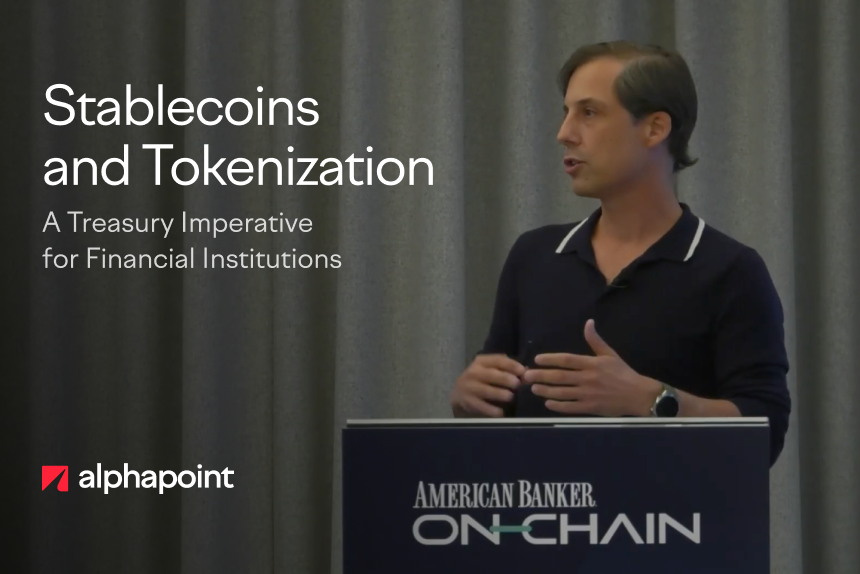
As Joaquin Ayuso de Paul, Chief Product Officer at AlphaPoint, explained during his ON-CHAIN lightning talk, this shift represents not just a technological change but a significant shift in control.
Stablecoin Access Is No Longer the Problem. Operating at Scale Is
For most institutions, the challenge isn't about accessing stablecoins anymore; the real issue lies in managing them with the same level of control, visibility, and reliability that they expect from their treasury systems.
Many institutions still run on batch-based treasury operations, pre-funded global accounts, and fragmented systems across wallets, exchanges, banks, and internal workflows. That structure creates trapped capital, operational inefficiency, and limited visibility across the movement of funds.
This is where stablecoin adoption becomes a treasury problem, not just a payments problem. Moving value in real time is only useful if institutions can manage that movement with policy controls, reporting, compliance workflows, and operational scale. Therefore, the real concern isn’t just gaining access to stablecoins but the ability to operate them institutionally.
Stablecoins and Tokenized Deposits Will Coexist
One of the most important distinctions in the market today is the difference between tokenized deposits and stablecoins.
Tokenized Deposits: These represent digitized bank money. They function within the banking system under established regulations, much like traditional deposit accounts.
Stablecoins: Designed for seamless value transfer across borders and platforms, stablecoins enable real-time transactions, even outside of regular banking hours.
This does not make tokenized deposits and stablecoins direct competitors, as they both solve different problems.
Tokenized deposits can help digitize value already held inside the banking system. Stablecoins can help move value across a global, always-on financial system. Institutions will likely need both as the market matures. The focus should be on developing the infrastructure to manage them effectively in a compliant and scalable treasury environment.
The New Financial Stack
With the growth of digital assets, institutions need to consider more than just access. The future financial stack includes three layers:
- Asset layer: stablecoins, tokenized deposits, tokenized real-world assets, and other blockchain-based instruments.
- Execution layer: smart contracts, programmability, automated strategies, and policy-based controls.
- Access layer: APIs, interfaces, and integrations that connect these assets and execution logic to institutional systems.
The most significant change occurs in the execution layer. Simply holding tokenized assets is just the beginning; the real advantage lies in automating their operations. Institutions can automate how capital moves, how liquidity is allocated, how payments are approved, and how policy rules are enforced.
That is what makes a stablecoin treasury fundamentally different from a traditional treasury, because it is faster and programmable.
What Actually Changes for Institutions
The impact of stablecoins is not limited to faster payments. It changes how institutions manage liquidity, revenue, and operations.
Liquidity Becomes Real-Time
In the traditional model, institutions often wait days to move capital and have to plan treasury strategies around weekends, holidays, and banking hours.
With stablecoins, capital can move instantly. Institutions can rebalance liquidity continuously and respond to market needs in real time.
Impact: Better capital efficiency and faster decision-making.
Treasury Opens New Revenue Models
Stablecoin infrastructure also creates new ways for institutions to generate value from treasury operations.
Through yield strategies, spread capture, and programmable treasury flows, institutions can turn treasury from a purely operational function into a stronger revenue layer.
Impact: Treasury becomes a profit center, not just a back-office cost.
Settlement Cycles Compress
Traditional treasury still depends on T+1 or T+2 settlement cycles, with manual reconciliation and delayed visibility.
Stablecoin rails move settlement closer to T+0, with real-time tracking across the movement of funds.
Impact: Reduced operational overhead, faster cycles, and better visibility.
Programmable Money Without Governance is Programmable Risk
The potential of stablecoins for institutions goes beyond mere automation. In fact, automation without appropriate governance can heighten risks significantly.
As Joaquin pointed out during the talk, programmable money without governance becomes programmable risk. For regulated institutions, the value of stablecoin infrastructure depends on whether controls can be embedded directly into how money moves.
That means moving from process-based controls to system-based controls. Instead of relying only on manual reviews, disconnected APIs, or after-the-fact monitoring, institutions can enforce wallet permissions, KYC-linked transfers, transaction rules, policy approvals, sanctions checks, and audit trails directly within the execution layer.
The Competitive Reality for Institutions
If customers can move money instantly through exchanges, stablecoin issuers, and crypto-native platforms, financial institutions risk losing their central role in the flow of funds.
Stablecoin payments involve multiple critical components, including liquidity management, compliance, beneficiary handling, wallet infrastructure, and reporting. Therefore, adopting stablecoins requires a comprehensive treasury infrastructure rather than relying on fragmented tools or manual processes.
Institutions need systems that allow them to:
- Manage stablecoin inflows and outflows
- Onboard and control beneficiaries
- Enforce internal approval policies
- Support mass disbursements and payment flows
- Monitor transaction risks
- Connect fiat, stablecoin, and tokenized asset operations
- Maintain visibility across every movement of funds
This approach is essential for functioning effectively in a 24/7 financial system.
AlphaPoint Treasury: Institutional Control for Real-Time Money
AlphaPoint Treasury is designed for institutions that need to manage stablecoins with the same level of control, governance, and operational discipline expected in traditional finance.
The platform supports stablecoin treasury workflows across payments, invoicing, beneficiary management, mass disbursements, and institutional liquidity operations. It is built for organizations that need policy-driven controls, compliance tooling, auditability, and scalable infrastructure for real-time financial operations.
As stablecoins become a larger part of institutional finance, access alone will not be enough. Institutions need to own the flow, define the logic, and control how money moves across systems.
Stablecoins are changing the speed of finance.
Ultimately, it will be the treasury that determines which institutions maintain control.
Keep exploring