BLOG ARTICLE
Treasury Rails: Stablecoins, Tokenized Markets, Regulation


Bitcoin entered the final days of September near $84,000, roughly 35% above its August low of $62,000, after briefly trading above $87,000. The move came despite tighter financial conditions following the Federal Reserve's first rate hike in more than three years, with the target range raised 25 basis points to 3.75%-4.00% and 16 of 18 policymakers projecting at least one additional increase this year.
U.S. spot Bitcoin ETFs recorded $998.95 million in net inflows on September 21, their largest daily inflow since October 2025. BlackRock's IBIT led with $381.4 million, followed by ARKB at $289.1 million and Fidelity's FBTC at $238.8 million. Spot Ether ETFs added another $269.98 million.
JPMorgan noted that Bitcoin and gold ETF flows have both recovered since late July, but gold funds have recaptured all of their earlier 2026 outflows while Bitcoin ETFs have recovered roughly half. Short interest in IBIT remains near its highest level of the year, suggesting Bitcoin is still more heavily hedged than gold despite renewed inflows.
Leverage also reset into quarter-end. Bitcoin open interest fell nearly 20% from August to its lowest level since March, while perpetual positioning moved closer to neutral. Glassnode identified $84,000-$85,000 as the largest long-term holder supply cluster, leaving sustained spot and ETF demand as the main counterweight to higher real yields and a still-cautious positioning backdrop.
Clarity Act Stalls as Regulatory Focus Shifts Back to Agencies
The Clarity Act failed to advance in the Senate on September 15, with a 49-50 procedural vote falling short of the 60 votes required to move forward. JPMorgan said the bill is "not fully dead" because it remains on the Senate calendar and could be brought back for another vote, but described the remaining window for passage this year as extremely narrow.
The immediate market reaction was negative. Bitcoin fell 2.85% to about $75,756, Ether dropped 4.5%, XRP declined 9.2%, and Solana fell 5.4%. Crypto-related equities sold off more sharply, with Coinbase down more than 10% and Circle down 11.4%.
Attention has now shifted back to the SEC and CFTC, with both agencies saying after the vote that they intend to continue developing rules for the digital asset industry, including potential exemptions and guidance for tokenized securities and market structure. JPMorgan noted that agency rulemaking is less durable than legislation because future administrations can amend it and courts can challenge it.
We’ll be covering that regulatory backdrop in more detail on October 28 in our webinar on bank-fintech partnerships with Reba Beeson , General Counsel at Alphapoint, Grace Navas, Principal at Avane Strategies, and moderator Andrey Chabanov.
The discussion will look at the stalled market structure bill, the SEC's parallel custody work, what banks need to see from fintech partners, and how risk changes once a regulated institution effectively inherits part of a fintech’s supply chain. ⛰️ Register here
Coinbase and Citi Connect Stablecoin Payments to Bank Rails
Coinbase and Citi are deepening their payments integration to give businesses a more direct path between fiat and stablecoins. Coinbase is using Citi's Virtual Account Wallet to power Coinbase Virtual Accounts, allowing customers to accept, hold, and send fiat through bank-account-like accounts while incoming funds are automatically converted into stablecoins.
The arrangement works in both directions. Citi's institutional clients can now accept stablecoin payments through Spring by Citi, its merchant acquiring and settlement platform, without holding stablecoins themselves. Coinbase handles the blockchain payment and conversion layer, while Citi settles the proceeds in fiat as bank of record.
Citi operates across more than 180 countries and jurisdictions, while Coinbase said the integration addresses a market of more than 150 million stablecoin holders. The initial rollout begins in the U.S., with additional capabilities expected to follow.
Citi is also expanding its own token services to Japan and the UAE, bringing the program to seven jurisdictions. Separately, Citi is participating in planned tokenized deposit initiatives with other banks and is among a group of financial institutions exploring shared stablecoin infrastructure.
Compliance Moves Upstream in Stablecoin Treasury
Alphapoint and Sumsub published a joint report examining where compliance needs to sit in a stablecoin payout flow. The core issue is timing: traditional wires can take one to five business days, leaving room for additional review, recalls, and manual intervention. Stablecoin settlement can complete in seconds, so those controls have to happen before execution rather than after funds are already moving.
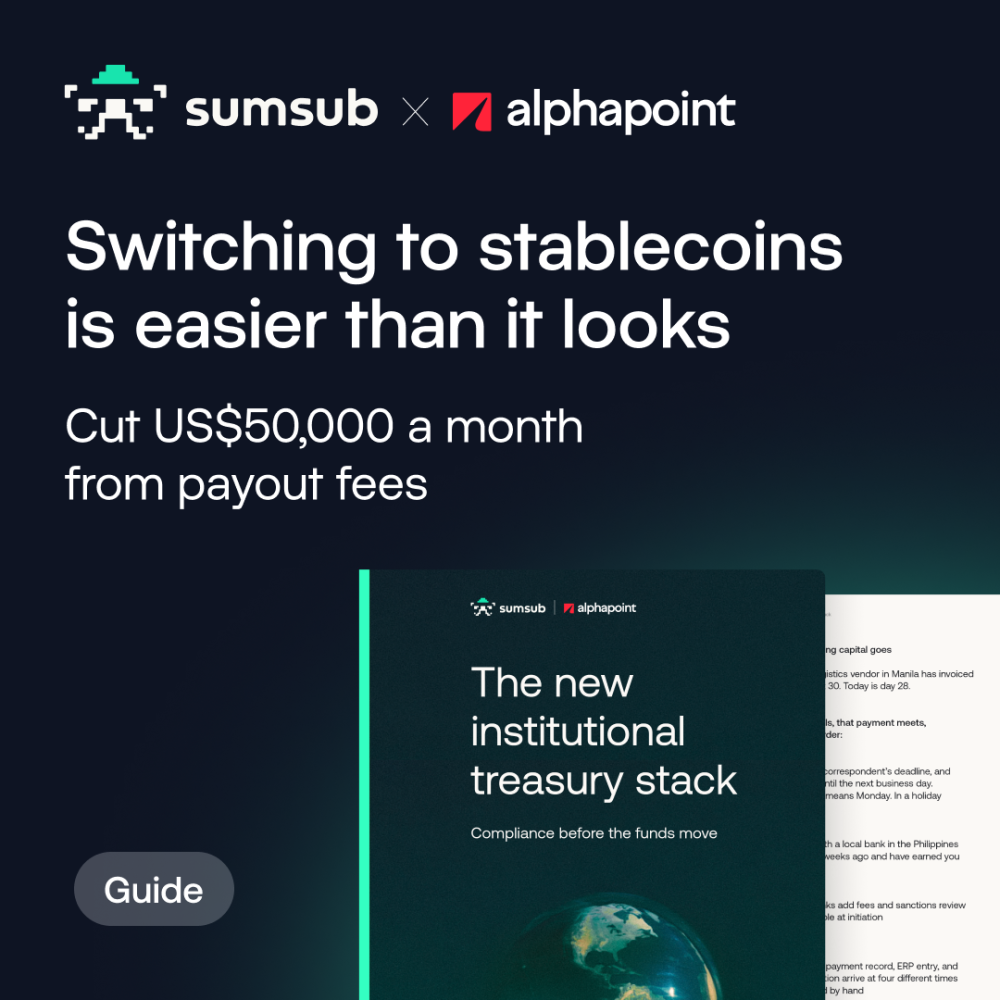
The report maps that shift across the payout lifecycle, combining Alphapoint's treasury orchestration, policy, approval, and audit controls with Sumsub's KYB, wallet risk, transaction monitoring, and Travel Rule capabilities. It shows how checks can be applied at organization onboarding, beneficiary creation, wallet address entry, and immediately before execution.
The economics are part of the case as well. At a 1% all-in rate, US$5 million in monthly payout volume equates to US$50,000 in fees, while pre-funded accounts, correspondent routes, and cut-off windows can also trap working capital. Stablecoin rails reduce those frictions, but only if compliance is embedded into the flow.
One example in the report follows a US$500,000 payout from ERP instruction through screening, policy evaluation, approval, settlement, and audit record creation. It also covers wallet risk scoring across 350+ blockchains, Travel Rule connectivity across five protocols, and an eight-question readiness checklist for teams moving stablecoin payout programs into production.
Tokenized Securities Move Closer to Mainstream Market Infrastructure
Blockchain.com and the New York Stock Exchange signed an agreement to connect Blockchain.com's users to NYSE's planned digital trading platform for tokenized U.S. stocks and ETFs. The service remains subject to regulatory approval and the launch of NYSE's digital ATS, but the planned model includes 24/7 trading, fractional shares, stablecoin funding, and immediate onchain settlement.
The distribution opportunity is significant. Blockchain.com has more than 44 million confirmed accounts, while NYSE would gain another channel for extending tokenized securities beyond traditional brokerage infrastructure. The agreement also includes reciprocal market-data distribution, with ICE Data Services planning to distribute Blockchain.com's crypto data and Blockchain.com adding ICE and NYSE stock feeds to its app.
Ondo Finance is moving in a similar direction from the portfolio side. It launched three onchain portfolio tokens based on model strategies developed by BlackRock, covering income, diversified growth, and high-growth allocations for eligible non-U.S. investors. Investors mint or redeem a single token representing the underlying basket, while holdings, weights, and rebalances remain visible onchain.
Ondo Stocks reached $1 billion in TVL within eight months, while Blockchain.com already offers more than 200 tokenized stocks and ETFs outside the U.S. through Ondo Global Markets.
Stablecoin Rules Move From Legislation Into Implementation
The Federal Reserve and Office of the Comptroller of the Currency are moving deeper into implementation of the GENIUS Act ahead of its January 2027 effective date, with both agencies proposing rules around how payment stablecoins can be issued, backed, supervised, and redeemed.
The Fed's latest proposal would require payment stablecoins to be fully backed by short-term Treasury bills or other highly liquid assets, while introducing standardized capital and risk-management requirements. It would also establish a specific application process for board-supervised banks seeking approval to issue stablecoins.
The OCC's proposal covers reserve standards, redemption at par, liquidity controls, audits, examinations, custody, capital, and application pathways for new issuers. It also defines which entities can qualify as permitted payment stablecoin issuers and extends federal oversight to certain foreign issuers seeking access to the U.S. market.
Bank Secrecy Act and sanctions requirements are expected to be finalized separately with the Treasury Department. Federal Reserve Governor Michael Barr said he supports the latest proposal but raised concerns about how anti-money-laundering deficiencies would be treated under the new framework. The OCC opened a 60-day public comment period, while the statutory regime is expected to take effect no later than January 2027.
Sources & Market Signals
- Federal Reserve | September FOMC Statement | The Fed raised the target range by 25 basis points to 3.75%-4.00%, its first increase in more than three years.
- Coinbase | Coinbase Brings Bank-Grade Fiat and Stablecoin Payments to Businesses, in Collaboration with Citi | Coinbase selected Citi's Virtual Account Wallet to power Coinbase Virtual Accounts, while Citi institutional clients can accept stablecoin payments through Spring by Citi.
- Blockchain.com / NYSE | Partnership to Explore Global 24/7/365 Trading of Tokenized Securities | The companies plan to connect Blockchain.com users to NYSE's proposed digital ATS for tokenized U.S. stocks and ETFs, subject to regulatory approval.
- Ondo Finance | Introducing Ondo Intelligent Portfolios | Ondo launched three single-token portfolios based on model strategies developed by BlackRock for eligible investors outside the U.S.
- Sumsub | The New Institutional Treasury Stack: Compliance Before the Funds Move | Alphapoint and Sumsub map how KYB, wallet screening, policy controls, approvals, transaction monitoring, and Travel Rule checks fit into stablecoin payout flows.
- Federal Reserve | GENIUS Act Stablecoin Rulemaking | The Fed proposed reserve, capital, risk-management, custody, and application standards for Board-supervised payment stablecoin issuers.
- OCC | GENIUS Act Regulations: Notice of Proposed Rulemaking | The OCC proposal covers reserves, redemption, risk management, audits, custody, supervision, capital, and registration requirements for permitted and foreign payment stablecoin issuers.
- OCC | GENIUS Act AML, CFT and Sanctions Proposal | The OCC separately proposed Bank Secrecy Act, AML/CFT, and sanctions compliance standards for supervised payment stablecoin issuers.
Keep exploring