BLOG ARTICLE
Crypto Fintech & PSP Solutions: Enterprise Payment Infrastructure for Banks and Financial Institutions


The fintech revolution in crypto payment infrastructure is no longer a speculative bet,it's a competitive imperative for banks and payment service providers. Stablecoin transaction volume exceeded $33 trillion in 2025, surpassing Visa's annual throughput, while real-world stablecoin payments doubled in 2025 to $400 billion, with an estimated 60% attributed to B2B use cases.
For CXOs evaluating crypto fintech and PSP solutions, the strategic question is straightforward: How do you integrate institutional-grade digital asset infrastructure without compromising compliance, security, or operational stability?
This guide cuts through vendor noise and regulatory complexity to focus on what actually matters: deployment architecture, compliance frameworks, and the real-world integration patterns that leading institutions are using today.
Why Crypto Payment Solutions Matter Now
Traditional payment rails, dominated by SWIFT, correspondent banking, and multi-day settlement cycles, were designed for a different era. For regional banks and payment service providers, this legacy infrastructure creates competitive friction and cost drag, particularly on cross-border corridors.
The operational case is compelling:
Visa's stablecoin settlement volume hit a $4.5 billion annualized run rate by January 2026, up 460% year-over-year. Visa, Mastercard, Stripe, Ramp, Meta, Cloudflare, Klarna, Western Union, Intuit, Fiserv, Zelle, and PayPal have all integrated or announced plans to adopt stablecoin rails.
The performance advantage is undeniable. Crypto payment processing delivers:
- Settlement speed: Minutes vs. 3-5 business days
- Operational hours: 24/7/365 vs. traditional banking hours
- Cost transparency: Programmatic fees vs. opaque correspondent spreads
- Audit trail: Complete on-chain visibility vs. fragmented correspondent logs
- Programmability: Smart contract-native automation vs. manual processes
For PSPs serving emerging market corridors or handling high-volume payment flows, these aren't marginal improvements,they're category shifts in what becomes operationally feasible.
The Compliance Foundation: GENIUS Act and Regulatory Clarity
The regulatory clarity that institutions have been waiting for arrived in 2025.
President Trump signed the Guiding and Establishing National Innovation for US Stablecoins (GENIUS) Act into law on July 18, 2025, establishing the United States' first comprehensive federal regulatory framework for payment stablecoins. The legislation passed with strong bipartisan support (308-122 in the House, 68-30 in the Senate).
What the GENIUS Act establishes for crypto compliance solutions:
- 1:1 reserve backing using high-quality liquid assets (US dollars, insured deposits, T-bills with ≤93 day maturity)
- No rehypothecation of reserves
- Monthly public disclosures and management certifications
- AML/BSA alignment placing stablecoin issuers under Bank Secrecy Act requirements
- Regulatory clarity that compliant payment stablecoins are neither securities nor commodities
The OCC issued a Notice of Proposed Rulemaking in February 2026, with full implementation expected between 2026 and 2027.
Parallel to US action, the EU's Markets in Crypto-Assets (MiCA) regulation imposed mandatory 1:1 reserve backing, comprehensive AML/KYC compliance, and regular audits on stablecoin issuers across all 27 member states.
For banks and PSPs, this convergence of regulatory frameworks means the compliance path is now defined. The question is no longer whether to move forward,it's how quickly to execute.
Enterprise Crypto Solution Architecture: What Separates Production from Pilot
Successful crypto fintech and PSP solutions deployments share common architectural patterns. Understanding these patterns determines whether your institution builds defensible competitive advantage or simply adopts another point solution.
Crypto Payment Gateway Infrastructure
The entry point for most institutions is a white-label crypto payment gateway solution that sits between your existing settlement systems and blockchain-based stablecoin rails. This layer handles:
- Wallet management: MPC (Multi-Party Computation) custody eliminating single points of key compromise
- Liquidity connectivity: Real-time stablecoin exchange and on-ramp/off-ramp integration
- AML/sanctions screening: Wallet-level OFAC compliance and blockchain analytics
- Settlement routing: Multi-chain optimization across Ethereum, Solana, and Tron
- Reconciliation: Real-time, audit-ready transaction reporting
For PSPs, this is the crypto payment processing layer that replaces or augments ACH, RTP, and wire settlement.
Custody and Reserve Management
Enterprise crypto custody solutions for institutions must meet standards equivalent to traditional asset custodians:
- Non-custodial wallet architecture where the institution retains control
- Institutional-grade key management (MPC with quorum structures)
- Insurance and fidelity bonding
- Segregation of client assets from operational funds
- Audit-ready reserve verification and reconciliation
The FDIC clarified in April 2026 that stablecoin reserves may qualify for pass-through deposit insurance, with tokenized deposits treated under the same framework as traditional deposits.
Compliance Integration: AML, KYC, and Travel Rule
A crypto compliance solution that doesn't integrate real-time monitoring is incomplete infrastructure.
Operational requirements include:
- KYC/KYB at scale: Wallet-based identity verification and blockchain address attribution
- Continuous AML monitoring: On-chain transaction pattern detection, mixer usage flagging, cross-chain bridge monitoring
- OFAC screening: Real-time SDN list matching at the wallet address and counterparty level
- Travel Rule implementation: FATF-compliant originator/beneficiary information for cross-border flows
- SAR automation: Behavioral pattern detection tuned for on-chain activity (not wire transfer thresholds)
The Wolfsberg Group released guidance in September 2025 on banking services for fiat-backed stablecoin issuers, providing banks with a practical framework for customer due diligence when providing reserve management accounts or settlement services to stablecoin issuers.
Three Deployment Patterns for Banks and PSPs
Pattern 1: Treasury Automation
Regional banks can deploy treasury automation solutions using stablecoin infrastructure to optimize idle operating capital. Integration typically involves connecting your treasury management system to institutional stablecoin infrastructure, establishing MPC wallet accounts for operating reserves, and enabling real-time yield management across cash equivalents.
EY-Parthenon research found that 54% of non-users expect to adopt stablecoins within 6-12 months, with treasury management cited as a primary use case alongside cross-border supplier payments.
Pattern 2: PSP Settlement Layer
For payment service providers, the highest-impact deployment is PSP settlement layer infrastructure where stablecoins serve as the settlement instrument between PSP and merchant, PSP and acquiring bank, or PSP and partner PSP. This requires integration with liquidity providers, on-ramp/off-ramp banking relationships, and real-time reporting into back-office systems.
Pattern 3: White-Label Customer Service
Regional banks with existing business banking client bases can offer stablecoin-as-a-service (SaaS) to corporate treasuries. This model requires deeper investment in custody, compliance automation, and reporting capabilities,but creates defensible competitive positioning.
Selecting a Crypto Banking Solution: Key Evaluation Criteria
The crypto fintech vendor landscape is crowded with point solutions. Institutional-grade crypto banking solutions share these characteristics:
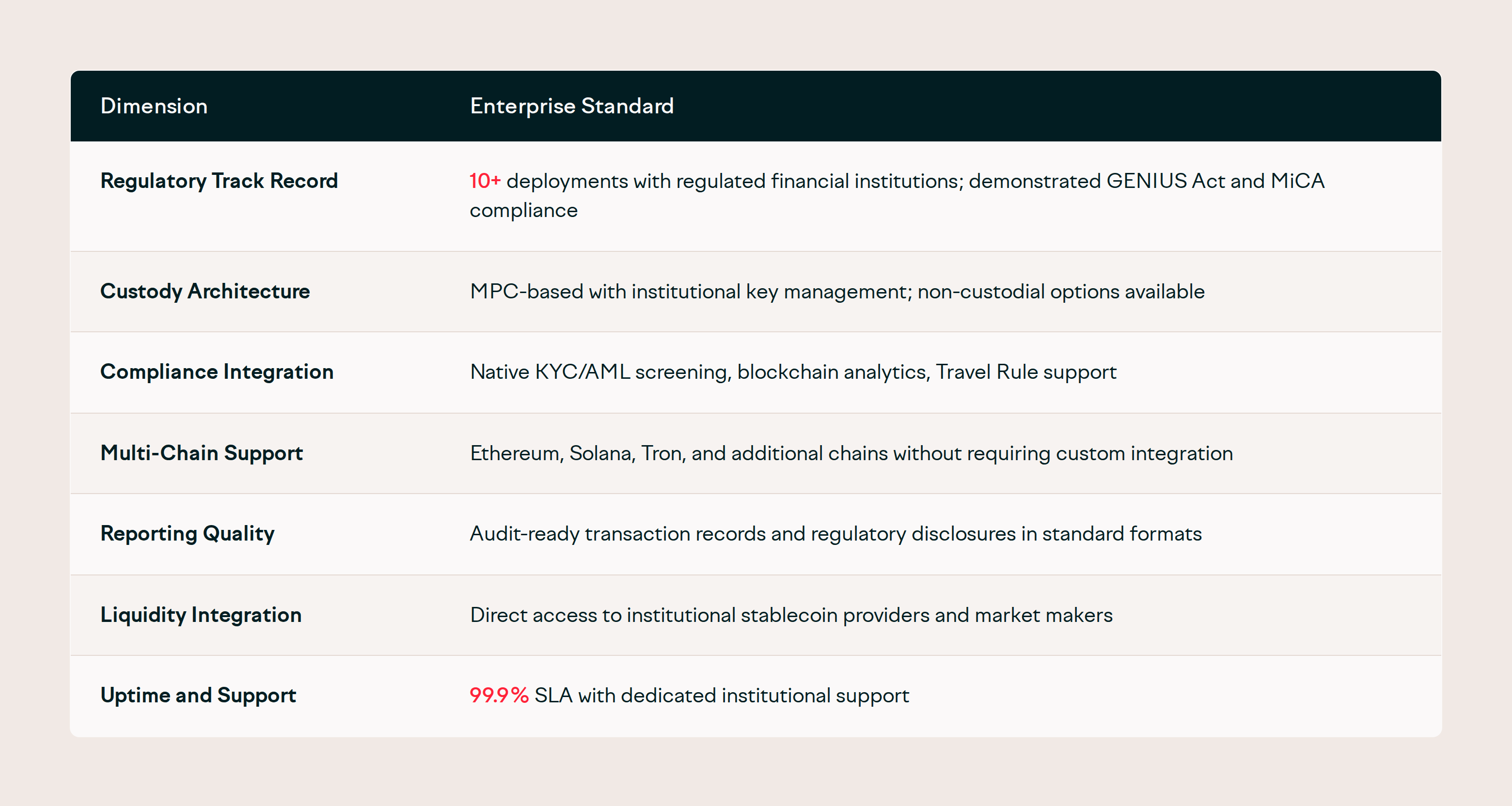
Avoid vendors that treat compliance as a bolt-on feature or require custom development for core regulatory functions. Institutional crypto solutions should have compliance embedded from architecture.
Real-World Implementation: The Checklist
For a PSP deploying solution crypto payments at scale:
- Define settlement corridors and target stablecoins (USDC, USDT primary; others by jurisdiction)
- Select chain architecture (Ethereum for institutional trust, Solana for throughput, or multi-chain)
- Establish MPC wallet infrastructure for settlement accounts
- Integrate banking connectivity for on-ramp/off-ramp operations
- Deploy KYC/AML monitoring at wallet and counterparty level
- Configure Travel Rule compliance for cross-border flows
- Build reconciliation and reporting into your back-office
- Obtain money transmitter or VASP licensing in operating jurisdictions
- Test with pilot corridors before scaling
The Infrastructure Partner Decision
The crypto fintech market has room for many vendors, but institutions need partners,not just tools. When evaluating a crypto banking software solution or broader digital asset infrastructure platform, focus on:
- Regulatory maturity: Has this provider deployed similar institutions in your jurisdictions?
- Institutional track record: Can they provide client references in banking and payments?
- Architecture depth: Do they handle compliance as a systems requirement or a feature request?
- Custody standards: Is MPC custody the default, or does it require additional licensing?
- Operational readiness: Can they support your go-live timeline without consulting engagements?
Legacy infrastructure providers are adding crypto capabilities (usually through acquisition). Purpose-built digital asset infrastructure providers have deeper expertise in the compliance and custody complexity that regulated institutions cannot get wrong.
Start Your Institutional Crypto Integration
The stablecoin infrastructure moment for banks and PSPs is now. Regulatory clarity has arrived. Production-grade infrastructure exists. The competitive risk of waiting now outweighs the risk of moving forward.
If your institution is evaluating crypto fintech or digital asset infrastructure solutions:
- Book a brief consultation to discuss your payment corridors, treasury goals, and compliance requirements. We can identify quick wins and mapped out multi-year roadmap.
- Run a pilot on a specific corridor to validate operational and compliance assumptions before broader rollout.
- Access our infrastructure vendor evaluation framework designed specifically for regulated financial institutions.
The institutions building stablecoin infrastructure in 2026 will define the client relationships, correspondent networks, and product positioning that shape competitive advantage for the next decade.
FAQ
What's the difference between a crypto payment solution and traditional payment infrastructure? Crypto payment solutions settle in minutes on-chain rather than 3-5 business days through correspondent networks, operate 24/7/365, eliminate intermediary banks, and provide complete on-chain auditability. The primary trade-off is new compliance complexity and wallet management requirements, which mature infrastructure providers now handle natively.
Does the GENIUS Act apply to all crypto payments or just stablecoins? The GENIUS Act specifically regulates "permitted payment stablecoins",digital assets backed 1:1 by high-quality liquid assets. Non-backed cryptocurrencies (Bitcoin, Ethereum) are not directly affected, though institutions facilitating stablecoin settlement fall under the framework.
What does Travel Rule compliance mean for institutional crypto payments? FATF Travel Rule requires that originator and beneficiary information accompany transactions above thresholds, similar to wire transfer requirements. For crypto payments, this means wallet address identification and sanctions screening must be integrated into your settlement process.
Should we build crypto infrastructure in-house or partner? Most institutions partner for custody, compliance, and liquidity,the regulatory and operational complexity is too high for in-house development. Consider building only if you have the security engineering, compliance, and operational depth of large-scale financial infrastructure teams. For most banks and PSPs, institutional partners are the lower-risk path.
Which stablecoins should we support? USDC and USDT account for >95% of institutional stablecoin volume and have regulatory clarity under GENIUS Act and MiCA. If you're serving emerging markets, add USDT on Tron (which dominates in Asia-Pacific flows).
Keep exploring