BLOG ARTICLE
Custody Expands, Controls Tested. Coinbase and Deutsche Bank advance as ETF outflows and a screening outage test operators.

Custody expands as markets test the infrastructure
Coinbase received final approval for a national trust company. Deutsche Bank brought digital asset custody live for paying clients. The NYSE's planned tokenized securities venue selected the technology for its clearing ledger. In the first half of November, institutional infrastructure advanced while investors continued to withdraw capital from crypto funds.
That combination matters for exchanges, brokers and financial institutions deciding where to build. A custody approval can expand the choice of counterparties. A new settlement network can change how assets move. Neither, on its own, answers how an operator will fund settlement through a volatile weekend, authorize a sensitive transfer or keep trading when a critical service goes offline.
We follow the effect on custody relationships, liquidity and the operational dependencies behind an executable trade.
Capital is leaving ETFs as inflation keeps funding in focus
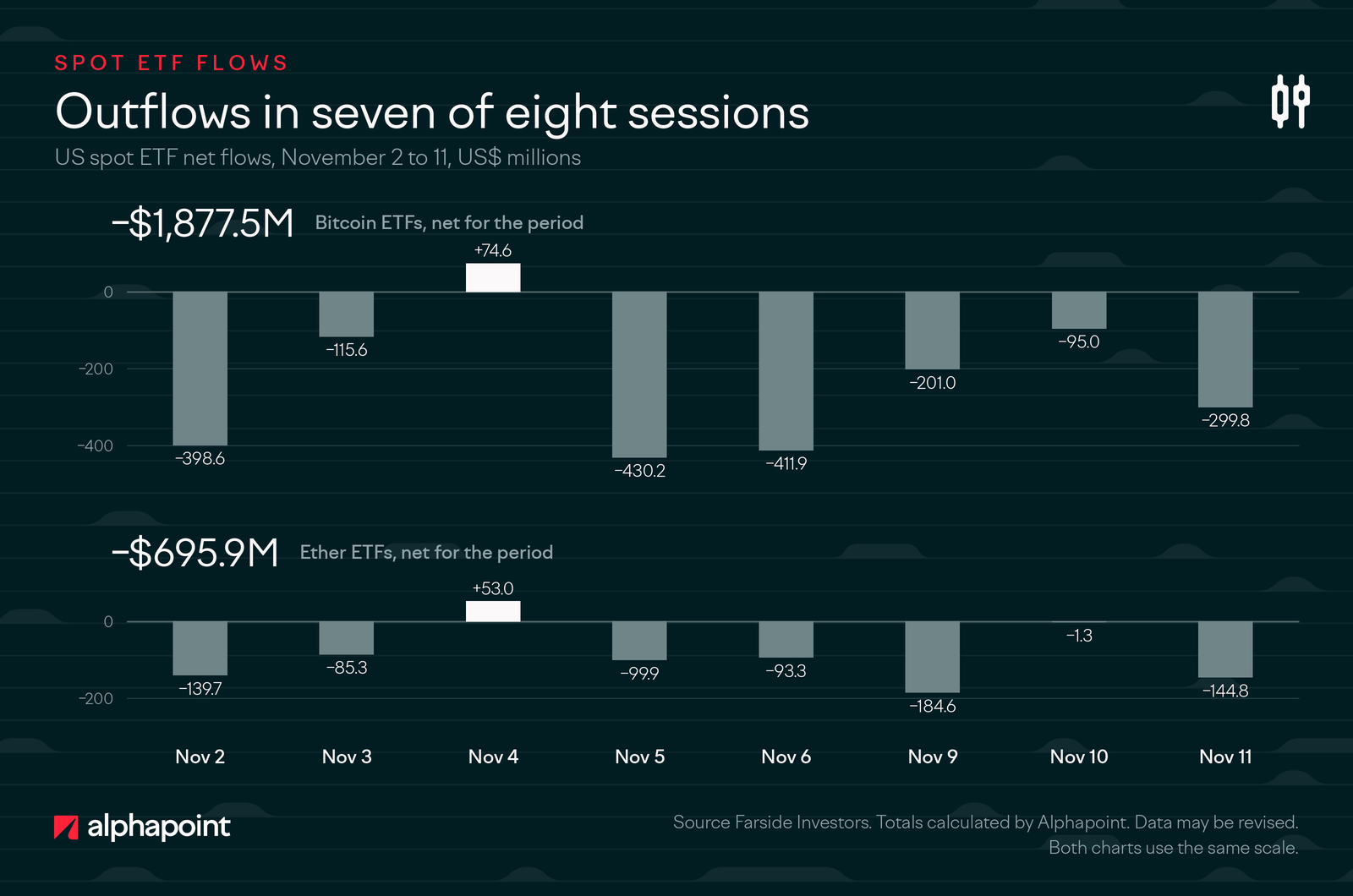
US spot bitcoin ETFs recorded approximately $1.88 billion in net outflows across the eight trading sessions from November 2 through November 11. Ether ETFs lost approximately $695.9 million over the same period. Those totals are calculated from Farside Investors' daily tables and remain subject to revisions. On November 11 alone, bitcoin funds lost $299.8 million and ether funds lost $144.8 million. Farside bitcoin flows · Farside ether flows
The macro backdrop adds pressure. October US consumer prices rose 0.4% month on month, following 0.6% in September, according to the November 10 CPI release. Separately, Reuters reported bitcoin at $73,708 and ether at $2,223 during the November 8 selloff, their lowest levels since August. BLS CPI release · Reuters market report
Our reading is that market infrastructure announcements and immediate capital allocation are moving on different schedules. For operators, the practical questions concern usable liquidity. How much inventory is available at each venue? What does it cost to replenish collateral? Can a withdrawal queue be met if a banking rail or screening provider is unavailable? ETF flows help describe one source of demand, but do not measure the depth available to execute a particular order.
Coinbase puts institutional custody under a federal trust framework
Coinbase announced on November 9 that the OCC had granted final approval to charter Coinbase National Trust Company. The announcement followed the regulator's April preliminary conditional approval. Coinbase describes the new framework as bringing federal uniformity to its custody business, building on its existing New York trust operation. Coinbase announcement
The scope deserves attention. The OCC's April decision described fiduciary custody and related transactions for custody customers, alongside access to certain affiliate services. It also set out a planned migration of the existing custody business over the three-year de novo period. The new entity's authority relates to its trust activities. Coinbase's announcement did not establish when individual client accounts would migrate or detail every condition of the final approval. OCC April decision · Reporting on the final approval
For institutions, our interpretation is that a federal trust framework may simplify parts of counterparty review. The remaining diligence still concerns the service the client will actually use. Which entity holds the assets? Who can instruct a transfer? How are custody accounts connected to trading and financing services? What records establish the client's rights and the authority behind each movement?
For brokers choosing a custody partner, those operating arrangements will determine how the relationship works after onboarding, especially when assets must move between safekeeping and execution.
Deutsche Bank moves custody into a live client service
Deutsche Bank's digital asset custody service went live for paying clients on November 11, Reuters reported. The bank's own launch notice confirms BaFin approval and an initial European institutional and corporate focus. Supported assets include bitcoin and ether, alongside selected stablecoins or e-money tokens, including USDC, EURC and EURAU. Tokenized financial instruments remain on its roadmap. Deutsche Bank launch notice · Reuters launch report
Its September announcement described hardware protection for keys, separation of duties and approval by multiple people. It also described distinct warm and cold storage environments and controlled recovery arrangements. These details help explain the operating work behind a bank custody launch. Deutsche Bank service design
The commercial opening is a wider choice of regulated custody relationships for institutions. The integration work then extends to the client's own order management, reconciliation and treasury processes. A broker may execute at one venue and custody elsewhere. An asset manager may need a transfer approved under its own mandate before the custodian will release assets. Those boundaries require explicit ownership of instructions, exceptions and evidence.
The bank also signed a memorandum of understanding with Deutsche Asset Management to explore digital asset collaboration. That creates a potential link between custody infrastructure and asset management distribution, with the commercial and technical arrangements still to be developed.
4 NYSE brings tokenization into the clearing ledger
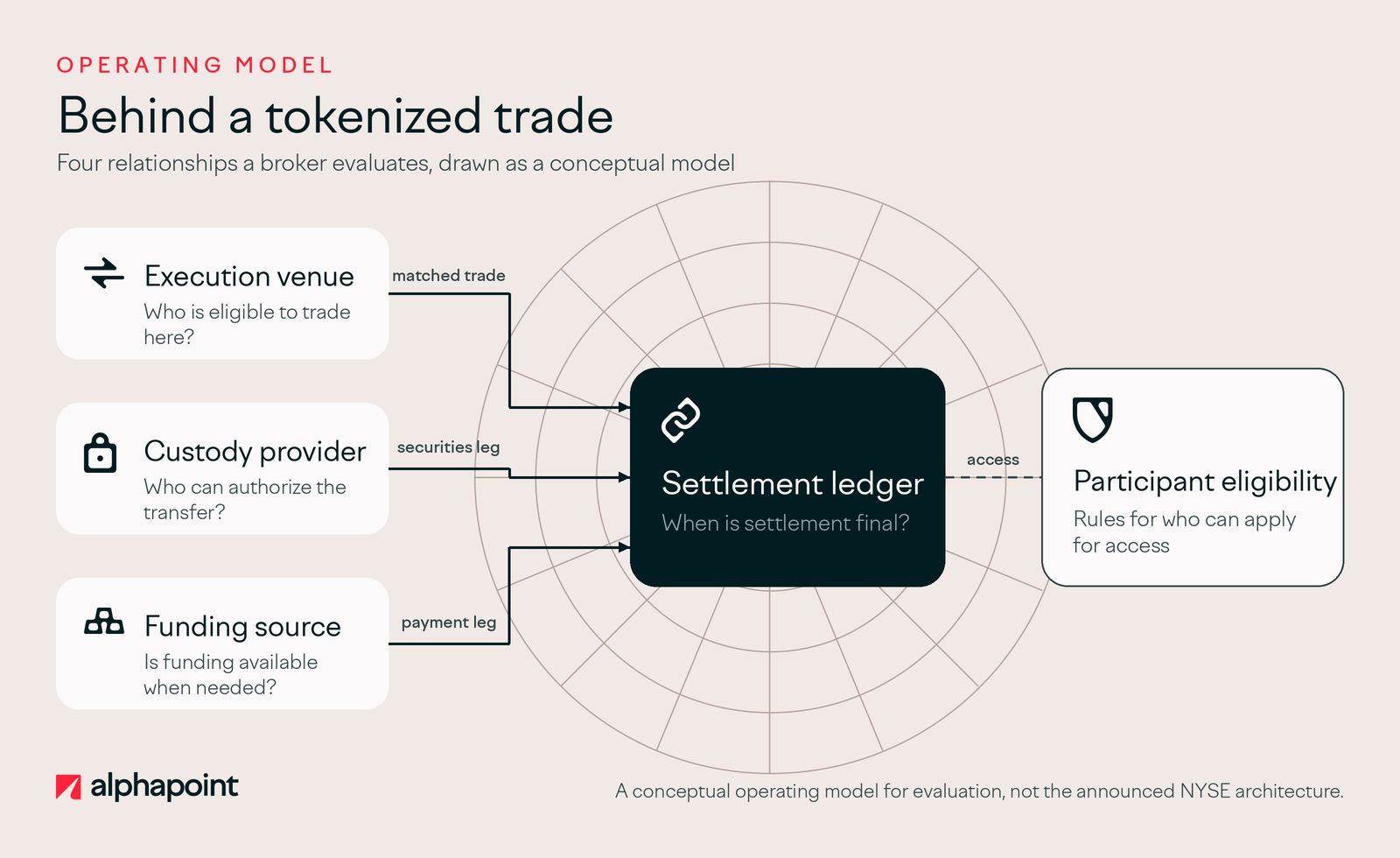
On November 9, Ava Labs announced that Avalanche would provide the core ledger technology to the clearing firm supporting an upcoming NYSE-affiliated digital alternative trading system. The planned platform is designed for continuous trading, clearing and settlement, subject to regulatory approvals. NYSE said the venue would support equities listed on different blockchains while using a ledger that can control participation and provide predictable performance. Ava Labs announcement
That places the infrastructure choice at the point where trades are recorded and settled. For a broker considering access, the chain on which a security exists becomes one part of a longer operating arrangement involving venue eligibility, custody and the asset used to pay for the trade.
Liquidity remains a separate hurdle. The IMF's October research found early evidence of continuous trading and fractional ownership in tokenized equities, alongside lower liquidity, greater fragmentation and higher volatility than in traditional counterparts. Its findings came from a small, developing market and should be read in that context. IMF tokenization research
Our implication for operators is straightforward. The ability to settle continuously creates a need to fund continuously. Before offering weekend access, a broker needs to know how inventory can be replenished, which settlement assets counterparties accept and what happens when a transfer is delayed. A longer trading window only becomes useful when clients can execute at acceptable prices and complete settlement.
The recovery of screening services exposes a trading dependency
Chainalysis restored Reactor, KYT and Address Screening on November 7, followed by Data Solutions on November 10, after its disclosed security incident. Its updates described exposed user information, password hashes and live tokens, as well as abnormal activity that led it to take monitoring services offline. Recovery steps included trusted IP allowlisting, password resets and API key rotation. Chainalysis incident updates
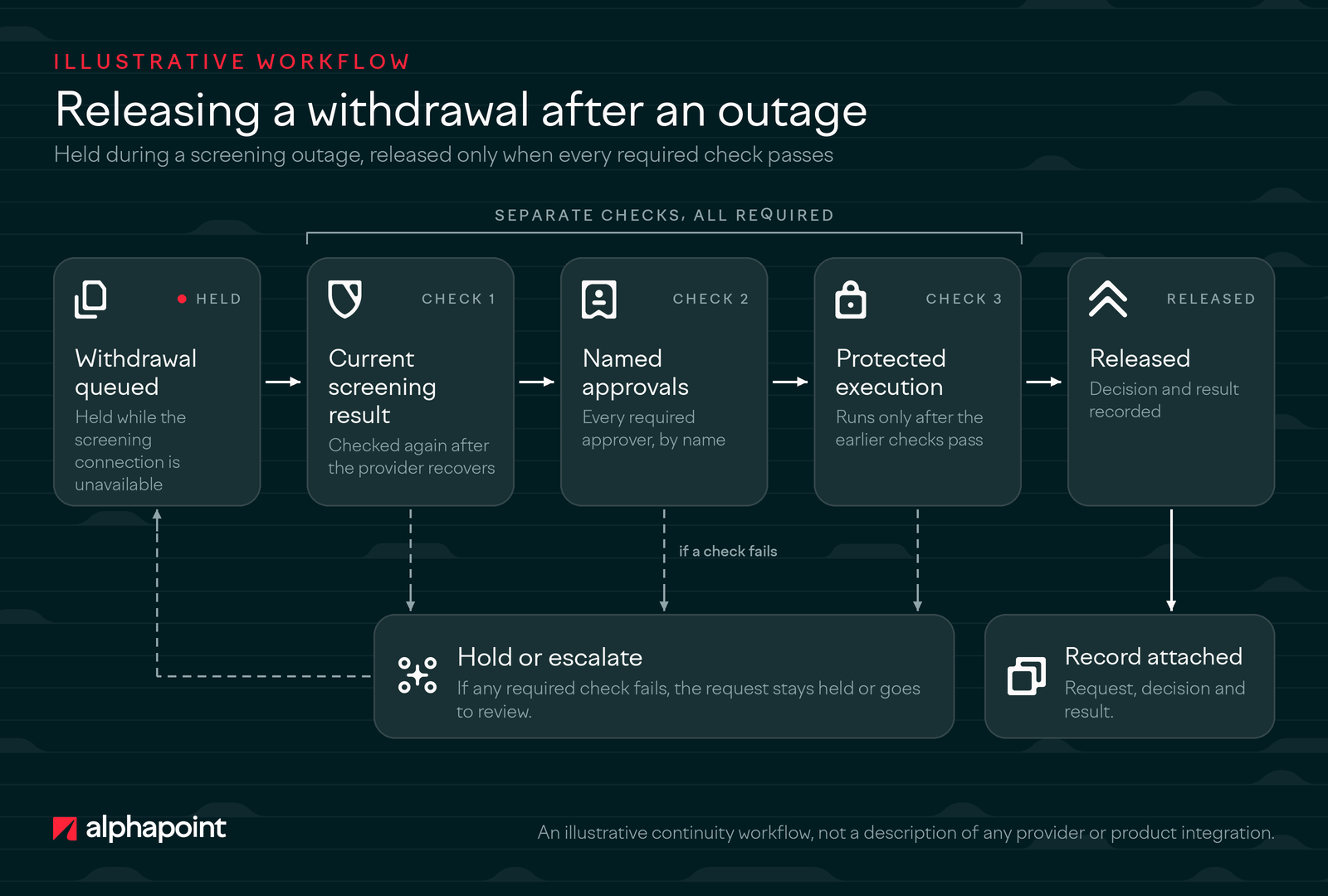
For a trading business, the consequence can extend beyond the affected vendor. A transaction may have sufficient balance and a valid customer instruction while still waiting on a screening decision. The operator then has to decide whether to hold it, route it through an approved alternative or escalate it for review. That decision needs an owner and a record.
A continuity exercise for this dependency would disable the screening connection in a test environment and follow a queued withdrawal through service restoration. The exercise should establish how requests are held, how changed credentials are deployed and how each request is screened and authorized before release.
The same discipline applies to emergency configuration changes. When a team changes an allowlist, appoints an alternative signer or reconnects a service, the change itself can affect the authority to move assets. Recovery planning has to cover those permissions as well as uptime.
Discuss the controls behind your market operations
At Alphapoint, these are the operating questions we want to examine with teams building digital asset services. Alphapoint Cloud is designed to protect sensitive operations through hardware isolation, policies for named approvals and signed records. The current product page describes what runs on our own development installation and identifies capabilities still in design.
If you are reviewing transfer approvals or the permissions used during an incident, we can work as a design partner on the requirements. A 30-minute Security Briefing can establish the scope, with an engineering discussion under NDA to follow. Explore Alphapoint Cloud and request a Security Briefing