BLOG ARTICLE
Markets Stay Open. Security Faces a Faster Test. Ethereum raises its security priority as vendor breaches, new venues and record ETF outflows test operators.


Security moves to the center of market infrastructure
The second half of November gave institutions new reasons to examine the systems behind digital asset markets. The Ethereum Foundation elevated protocol security as AI changes its view of emerging threats. JPMorgan, Visa and Mastercard disclosed incidents at outside vendors. US authorities moved to recover assets stolen from Binance.
Infrastructure kept advancing alongside them. OKXICE opened its tokenized securities venue, and DBS and Kinexys by J.P. Morgan connected their tokenized deposit networks for live cross-border transfers. Both arrived as US spot bitcoin ETF withdrawals reportedly reached a monthly record.
These stories belong in the same conversation. Every new route into the market adds systems, service providers and operating processes that clients depend on. This edition looks at what changed and the practical questions it raises for trading and security teams.
Ethereum puts AI-related risk higher on its security agenda
In a November 23 update, the Ethereum Foundation said it had doubled its protocol security team and made hardening the network a priority. Its assessment treats AI as a more immediate concern than quantum computing, citing how quickly models can now find software vulnerabilities. Source: Ethereum Foundation security update
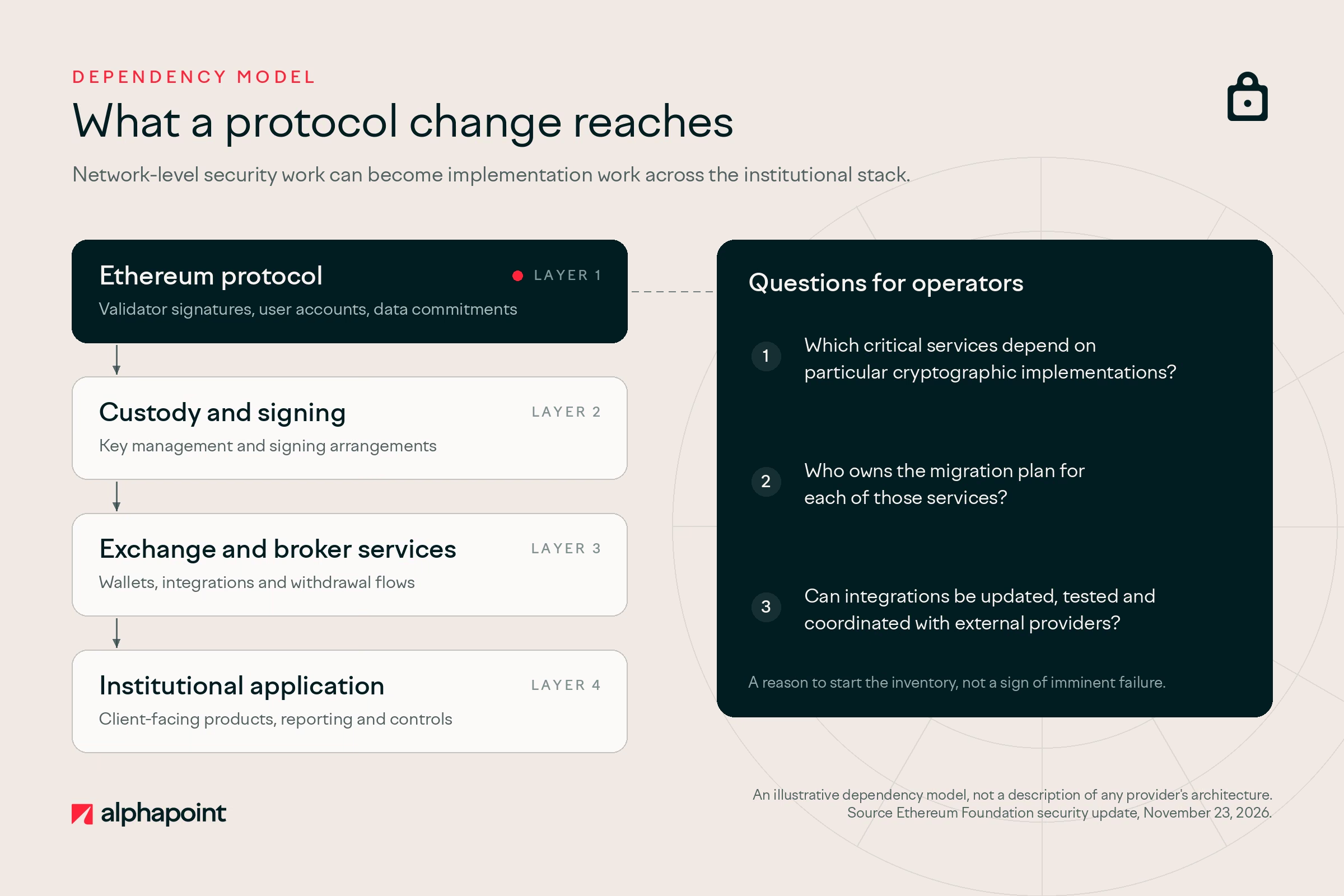
The proposed work covers validator signatures, user accounts and data commitments, with a move toward hash-based cryptography and formal verification of core components. These are development priorities and not protections already deployed across Ethereum. The announcement does not claim that AI can break the cryptography in use today.
Our reading is that institutions should treat this as a technology planning issue. A custody provider, exchange or asset manager needs to know how network-level changes could affect the services it runs, including its ability to update integrations, test new signing arrangements and coordinate changes with external providers.
A more immediate diligence question follows. How quickly can a provider investigate and fix a newly discovered vulnerability? A security review at onboarding says little about how that provider will respond when its dependencies change.
A useful next step for operators is to identify which critical services depend on particular cryptographic implementations, and who owns their migration plans. The announcement is a reason to start that inventory, not a sign of imminent cryptographic failure.
Vendor breaches at major financial firms put customer data in focus
On November 19, JPMorgan, Visa and Mastercard disclosed incidents involving third-party providers. JPMorgan said potentially exposed information included customer names and email addresses, and distinguished the incident from a separate processing disruption. Visa said its own systems and payment-card numbers were unaffected, and Mastercard said its payment network was unaffected. Reuters could not independently authenticate the data the attackers published. Source: Reuters vendor breach report
The distinction matters. A vendor data breach is not a compromise of a bank's payment systems, and information held outside those systems can still deserve close attention.
Our operational concern is impersonation. Exposed customer details can make a follow-up message more convincing, because a request that refers to a real relationship or service looks more credible than a cold approach. That is a potential follow-on risk, and these disclosures do not establish that it has happened.
For digital asset businesses, vendor reviews should extend beyond custody and trading providers to the services that handle customer communications, support and marketing, since they also hold information about the business and its clients.
A practical review starts with the data each provider actually needs. It then asks how staff would authenticate a sensitive customer request if the details normally used to recognize that customer were public. Incident communications should separate exposed information, affected services and the systems that remain operational.
The Binance recovery action shows why frozen and returned funds differ
On November 23, the US Justice Department announced a civil forfeiture action concerning more than $1.1 billion in USDC linked to the earlier Binance theft. The department said US efforts had helped freeze, seize or return more than $2.9 billion across multiple sources. The recovery action is new, and the underlying attack predates this edition's reporting window. Source: DOJ recovery announcement
Those categories should stay separate. The combined figure does not mean the full amount has been returned, and a forfeiture claim is one step in a recovery process, not confirmation that affected parties can use those funds.
For an operator preparing its own response plan, the distinction shapes liquidity management and customer communications. Assets identified onchain, assets restrained and assets available again are not interchangeable balances.
Our takeaway is that recovery readiness deserves attention before an incident. Teams need an established way to preserve transaction evidence, contact the relevant counterparties and track the status of affected assets. Finance and incident-response teams should work from the same record, with confirmed amounts kept apart from estimates.
Recovery can make real progress while operational uncertainty remains, and reporting that uncertainty accurately is part of managing the incident.
Bitcoin ETF outflows reach a reported monthly record of $4.71 billion
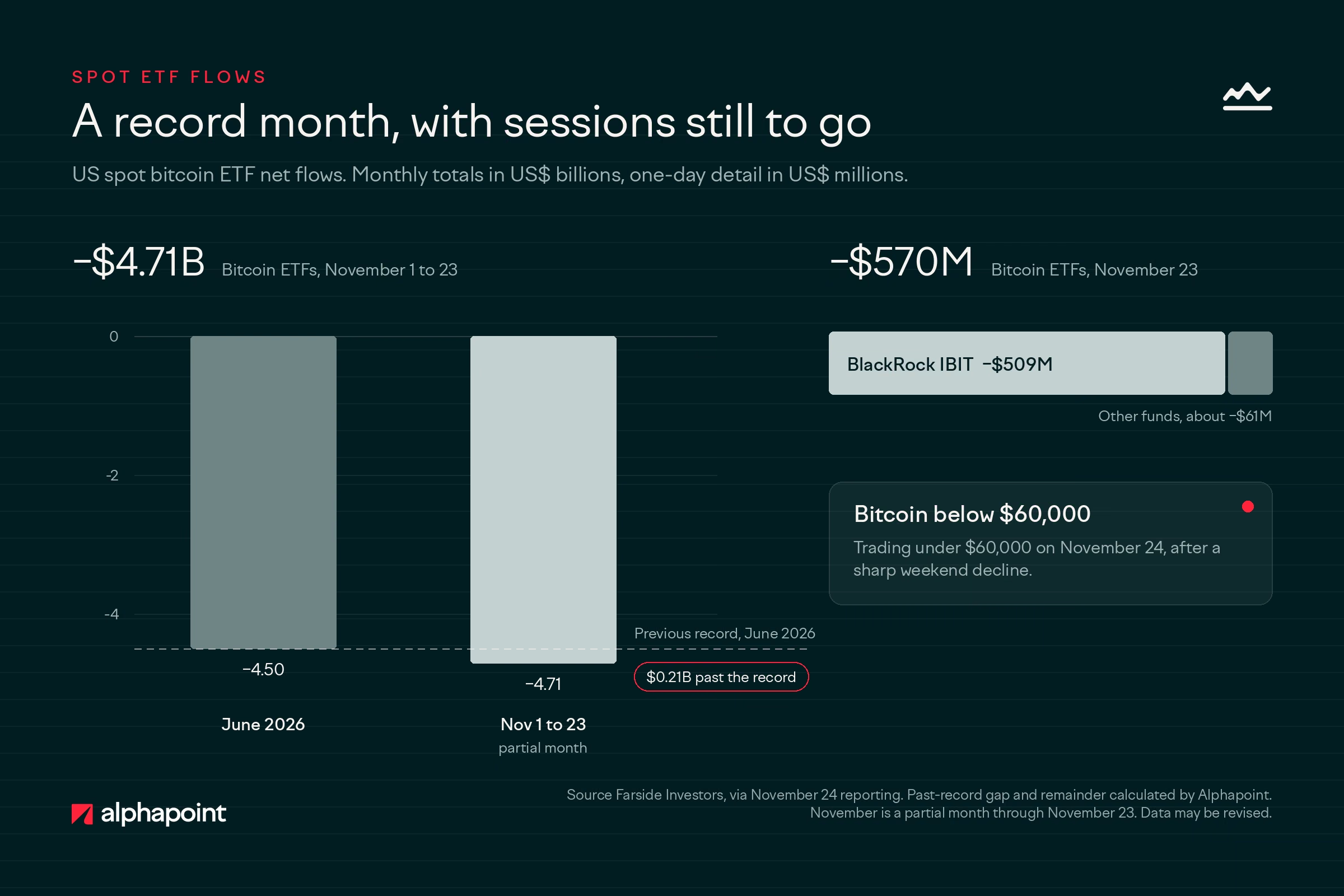
US spot bitcoin ETFs recorded $4.71 billion in net outflows in November through November 23, according to November 24 reporting citing Farside Investors. That passes the previous monthly record of $4.50 billion set in June, with several trading sessions still to go.
About $570 million left the funds on November 23 alone, including $509 million from BlackRock's IBIT. The withdrawals coincided with bitcoin trading below $60,000 on November 24, after a sharp weekend decline that Reuters reported took it as low as $55,251.60 on November 21.
The scale of redemptions puts this month's infrastructure launches in context. Institutions are gaining new ways to hold and trade digital assets while capital leaves a major investment channel. ETF flows do not describe every institutional position, but they show that expanding access does not guarantee sustained demand.
For brokers and exchanges, the practical question is how that selling pressure affects execution. Teams need to assess available depth, the cost of replenishing collateral and their ability to meet withdrawals during volatile sessions.
Security is part of that operating discipline. A volatile session can create pressure to speed up withdrawals, replenish balances or change operating limits. Stress testing should show whether the business can meet demand within its agreed controls, including when key staff or service providers are unavailable.
OKXICE brings tokenized securities into live trading
OKXICE launched its tokenized securities venue on November 23 for eligible US customers. Launch reporting identified 113 confirmed assets, and Securitize's announcement described that roster as a phased rollout, so the count should not be read as every asset trading immediately with active liquidity.
The launch gives institutions a live setting to assess the operating model behind continuous securities trading. The evidence to watch next is market quality, meaning available depth, spreads and the ability to enter or exit positions outside the underlying market's regular hours.
Our interpretation is that access alone will not settle the commercial case for brokers. Clients need clarity on what they hold, how corporate actions are handled and what happens when a transfer or redemption cannot complete immediately.
Security diligence belongs in that review. Teams considering a new venue should understand its dependencies, how material changes are communicated and how an incident would affect trading or asset movement. Those questions matter more when clients can hold and trade positions through hours that used to fall outside normal operations.
DBS and J.P. Morgan connect tokenized deposits across banking networks
DBS and Kinexys by J.P. Morgan launched a live interoperability service on November 16, enabling USD transfers between their permissioned blockchain-based accounts in Singapore and the United States. Ant International is the first client, using the service for treasury and liquidity management across entities in both markets, with Partior providing settlement orchestration.
This is a concrete step in cross-bank connectivity, with a named corporate client moving liquidity between two banking ecosystems.
One qualification matters to market operators. DBS says transfers within the Kinexys network run continuously, but movement between traditional demand deposit accounts and blockchain deposit accounts pauses for three hours on Saturdays, from 3 PM to 6 PM ET. The bank says an enhancement is in development.
That detail shows why institutions need to evaluate the full funding journey. Continuous settlement inside a network does not guarantee uninterrupted access from every external account.
For a business considering similar infrastructure, the review should follow funds from their starting account to their final use. It should establish when liquidity becomes available, how exceptions are handled and which team responds if the receiving system is unavailable, with security and reconciliation following the transfer across each boundary.
The commercial opportunity is more flexible use of cash across markets, and its practical value depends on how well the connected service fits the client's existing operations.

Alphapoint introduces the Approval Device
On November 20, we introduced the Approval Device, dedicated hardware that lets authorized employees review and approve sensitive requests on its own secure display, separately from their computers. It adds an independent checkpoint for actions such as administrative access, payment releases and critical system settings, which are the operations that vendor incidents and volatile sessions put under pressure.
If you are reviewing which actions in your operation need an independent approval, we can work as a design partner on the requirements, starting with a 30-minute security briefing under NDA. Arrange a security briefing
Sources and market signals
Ethereum Foundation, November 23. Doubled its protocol security team and prioritized network hardening against emerging AI and quantum risks. Proposed changes cover validator signatures, user accounts and data commitments. Source: Ethereum Foundation security update
Reuters, November 19. Reported third-party vendor incidents affecting customer information associated with JPMorgan, Visa and Mastercard. Visa and Mastercard said their payment systems were unaffected, and JPMorgan distinguished the incident from a separate processing disruption. Source: Reuters vendor breach report
US Department of Justice, November 23. Filed a civil forfeiture action concerning more than $1.1 billion in USDC linked to the Binance theft, and reported helping freeze, seize or return more than $2.9 billion across multiple sources, without confirming that the full amount had been returned. Source: DOJ recovery announcement
Farside Investors and November 24 reporting, November 1 to 23. US spot bitcoin ETF net outflows reportedly reached a monthly record of $4.71 billion. November 23 withdrawals totaled about $570 million, including $509 million from BlackRock's IBIT. Sources: Bitcoin ETF flows | November 24 ETF outflow report
Reuters, November 21. Reported bitcoin falling to $55,251.60 before recovering toward $60,000, after a broader retreat from risk assets. Source: Reuters bitcoin market report
OKXICE and Securitize, November 23. Launched a tokenized securities venue for eligible US customers, with 113 assets confirmed for a phased rollout. The confirmed roster does not establish that every asset was immediately available with active liquidity. Sources: OKXICE launch report | Securitize announcements
DBS and Kinexys by J.P. Morgan, November 16. Launched cross-bank USD transfers between permissioned blockchain-based accounts in Singapore and the United States, with Ant International as the first client. DBS disclosed a three-hour Saturday pause for transfers between traditional demand deposit accounts and Kinexys blockchain deposit accounts, separate from continuous on-network transfers. Source: DBS and Kinexys launch announcement