BLOG ARTICLE
Inside the Alphapoint and Sumsub Blueprint for Compliant Stablecoin Payments

Cross-border payments have always involved a hidden element of control: time. A wire takes one to five business days to settle, and that same window lets you recall a payment, recheck an address, and let a compliance officer catch what an automated screen missed. This delay, while often overlooked, actually serves as a safeguard.
Stablecoin rails eliminate this delay. A payout confirms in seconds, on a weekend as readily as a weekday, and it cannot be unwound by a phone call to a correspondent bank. For treasury teams, that is the upside and the problem in one: when settlement is final, there is no window left to catch anything after the fact. This means that control must shift to before the transaction is executed.
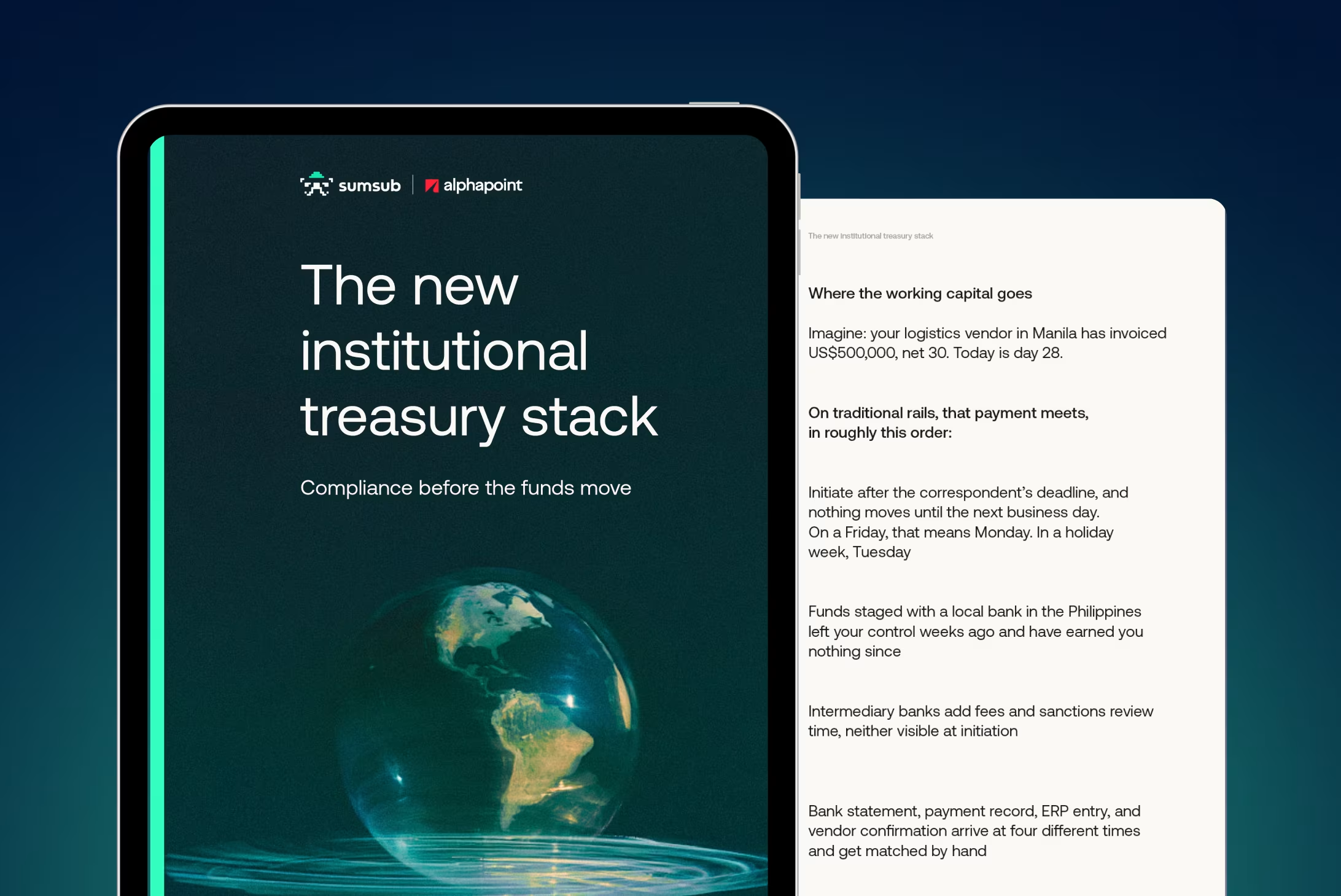
To explore what this shift looks like in practice, Alphapoint and Sumsub have collaborated on a joint report, The new institutional treasury stack: Compliance before the funds move, working through where payment risk shows up after approval, why point-in-time identity checks miss it, and what an integrated trust-and-movement layer looks like in practice.
Where working capital gets trapped
Picture a logistics vendor in Manila invoicing US$500,000, net 30. Today is day 28. On traditional rails, that single payment runs into four separate frictions before it clears:
- A cut-off window. If you initiate a payment after the correspondent bank's deadline, nothing moves until the next business day. For instance, if it's a Friday, the payment will not be processed until Monday; in a holiday week, it may take until Tuesday.
- A pre-funded balance. Funds staged with a local bank weeks ago left your control long before anyone needed them and have earned nothing since.
- A correspondent route. You don’t choose the intermediary banks involved in the transaction. These banks can impose additional fees and require time for sanctions reviews, which are not visible when the payment is initiated.
- A reconciliation problem. Bank statement, payment record, ERP entry, and vendor confirmation arrive at four different times and get matched by hand.
Now, multiply this scenario across eight different markets, each with its own banks, jurisdictions, and providers, and the honest answer to "what is our available liquidity right now" becomes a spreadsheet someone assembled this morning.
The cost compounds: at a 1% all-in rate, US$5 million a month in payout volume runs to US$50,000 a month in fees, and that is the floor, before bank fees, intermediary fees, FX spreads, and provider margins stack differently on every corridor.
From experiment to infrastructure
Stablecoins are no longer a fringe instrument; in fact, their share of crypto transactions by number rose from 31% in 2024 to 36% in 2025, five points in a year, which is well past experiment and short of a stampede.
What is driving it is not speculation; instead, institutions are using dollar-pegged stablecoins for work they were already doing, with the waiting removed:
- Cross-border vendor and supplier payments, especially where USD access matters or local rails are slow
- Contractor and payroll disbursement for global teams, with batch payouts, beneficiary management, approvals, and reconciliation exports
- Merchant and platform payouts across many recipients and jurisdictions at once
- Intercompany rebalancing between entities, regions, and markets
- Client-facing treasury services offered by banks, PSPs, fintechs, and exchanges
The pivotal moment comes when a bank starts to offer services involving stablecoin receipt, invoicing, payouts, and fiat conversion to its corporate clients. This development means that the bank's compliance responsibilities extend to its clients' counterparties, rather than being limited to its own transactions. Consequently, the buyer's involvement is no longer restricted to just the treasury team.
Speed removed a control nobody credited
The three days it takes for a wire transfer isn’t just a delay; it's time to recall a payment, verify an address, and allow a compliance officer to catch what an automated system might have missed. On-chain settlement removes that window entirely, which is why readiness, not speed, is where stablecoin programs stall.
The gap is measurable: only 23% of firms report being fully ready for the Travel Rule and FATF Recommendation 16. Meanwhile, 28% are actively working toward compliance, and 43% are uncertain about their status. Four in ten cannot say whether they would pass an inspection. The stakes are not theoretical: in March 2026, a South Korean exchange was fined US$24.6 million for AML and verification failures and handed a six-month partial operational suspension, the kind of penalty that reaches a CFO directly.
At the same time, 55% of crypto businesses reported experiencing fraud in 2025, and 74% of compliance leaders now prioritize screening accuracy over speed.
Within institutions, the discussion often divides predictably. The CFO, treasurer, and head of payments push for adoption: working capital, settlement speed, corridor expansion. In contrast, the CRO, CCO, CISO, legal, and controller decide whether it happens: counterparty exposure, KYB completeness, sanctions depth, key management, and auditability. A stablecoin project that wins the first group and loses the second never ships.
Compliance has to be clear before execution
When dealing with irreversible rails, the design principle is simple to state and hard to retrofit: every control has to run before the transaction is signed, not after it settles.
That means compliance is not a monitoring dashboard bolted on at the end. Instead, it is a set of gates built into the payment workflow itself, identity and business verification, sanctions and wallet screening, policy evaluation, and approval, each completing before funds move. A payment that should not go out is stopped at one of those gates, and there is nothing to investigate afterward because nothing left the building.
"Financial institutions should not have to choose between faster payments and stronger controls. They need compliance checks and approvals built into the payment workflow before funds move, with a clear audit trail through settlement. That is the standard we designed AlphaPoint Treasury to meet."
Scott Bambacigno, CEO & Co-founder, Alphapoint
A US$500,000 payout, gate by gate
Here is the Manila payment again, this time on an integrated stack. It typically completes in about the time it takes to read this section.
- Intent. ERP or treasury software initiates the payment, or an operator uploads it inside a batch of 44.
- Pre-flight screening. The entity is checked against registry, sanctions, and adverse-media data. The counterparty address is scored across 350+ chains. The transaction is evaluated for velocity, and a Travel Rule query runs where the counterparty is a VASP. This step takes approximately 15 seconds.
- Policy and approval. The amount crosses a second-signer threshold, the address is whitelisted, the asset and network are permitted, a velocity limit applies, and liquidity is confirmed in the required asset; the maker cannot self-approve. The separation of payment initiation and approval is a core treasury control. Our guide to stablecoin treasury permissions explains how institutions can assign responsibilities and enforce approval thresholds.
- Execution. The transaction is signed through configured custody and settles on-chain in seconds. Once completed, it is unrecallable.
- Record. One row captures initiator, approver, policy rule, compliance decision ID, risk score, hash, and status, ready for reconciliation, ERP, and reporting.
Every check sits before execution, ensuring there is no reliance on memory to remember policies on any given day.
The joint blueprint: Alphapoint and Sumsub
An integrated stack needs a clean division of responsibility. In this one, Alphapoint holds the payment intent, policy rules, liquidity position, and signing keys, while Sumsub holds the screening. An API and webhook connect the two at every checkpoint: organization and user onboarding, beneficiary creation, wallet-address entry, payment initiation, pre-execution review, and post-transaction monitoring.
At each gate, Alphapoint sends the context: entity and beneficiary IDs, wallet address, asset and network, amount, originator and beneficiary information, jurisdiction, purpose, prior compliance status, and Travel Rule status. In response, Sumsub provides a structured decision: pass, hold, high risk, or block, along with a risk score. Alphapoint's policy engine reads that result in conjunction with its own treasury rules and takes appropriate action.
The division of responsibilities is key. The decision-making authority rests with Alphapoint, while the evidence is Sumsub's. A compliance provider that could release funds would be a custody risk, and a treasury platform scoring its own counterparties would be marking its own homework. A high-risk result comes back as an explicit block or hold, never a soft warning, and policy decides what happens next: block before execution, hold for review, escalate to a senior signer, or restrict the beneficiary so one result governs every future payout to that address.
These operational requirements were also explored in our joint webinar with Sumsub, covering verification, wallet screening, Travel Rule compliance, and institutional treasury workflows.
Screening is a snapshot, not a guarantee
The most common error in on-chain treasury design is the practice of screening a wallet only once, at the time of beneficiary creation, and then treating the result as durable. An address that was clean in January might receive funds from a sanctioned mixer by March, and if you only screen once, you'll miss it.
Continuous re-screening closes that gap. Counterparty addresses are scored across 350+ blockchains for sanctions exposure, mixer and darknet links, and unhosted-wallet flags before every payout, with results aggregated across multiple analytics vendors rather than inheriting a single provider's blind spots.
For instance, a single payout of $500,000 to a screened vendor may seem unremarkable. However, if forty payouts of $12,500 each go to forty newly created beneficiaries, all resolving to the same chain, it becomes a pattern worth flagging, and no individual entity check catches it, because each entity looks fine on its own. Transaction monitoring across 600+ configurable risk scenarios covers exactly that: velocity, volume anomalies, and origin-and-destination risk, running across the full transaction lifecycle, including the payouts that execute at 2 a.m. on a Sunday.
The Travel Rule adds one more constraint: under the FATF Travel Rule framework, covered virtual asset transfers require relevant originator and beneficiary information to be collected, maintained, and transmitted in accordance with applicable requirements. This represents the largest self-reported readiness gap in the industry, and a reason to ask any vendor which corridors they actually cover.
Building a treasury stack that scales
Speed is the easy part of stablecoin treasury. The hard part is operating it with the control, visibility, and auditability institutions already expect from traditional finance, at volume, across corridors, without a compliance team becoming the limit on growth.
This is where Alphapoint Treasury comes in: one operating layer across supported stablecoins, chains, and wallets, with unified balance visibility, automated payouts, liquidity routing, and a policy engine that governs every movement. Founded in 2013 and backed by a Series A led by Galaxy Digital, Alphapoint has powered more than US$1 trillion in transaction volume for over 150 customers across 35 countries, among them exchanges, brokerages, payment networks, and banks.
Paired with Sumsub's verification, screening, and Travel Rule layer, it moves the compliance decision to the only point where a decision is still available: before the funds move.
For more details, read the full joint report, The new institutional treasury stack: Compliance before the funds move, for the complete gate-by-gate blueprint and the operational readiness checklist.
Or book a demo to explore how AlphaPoint Treasury supports institutional stablecoin operations.