BLOG ARTICLE
AI Agent Security in Finance: Designing Limits That Hold When an Agent Gets It Wrong

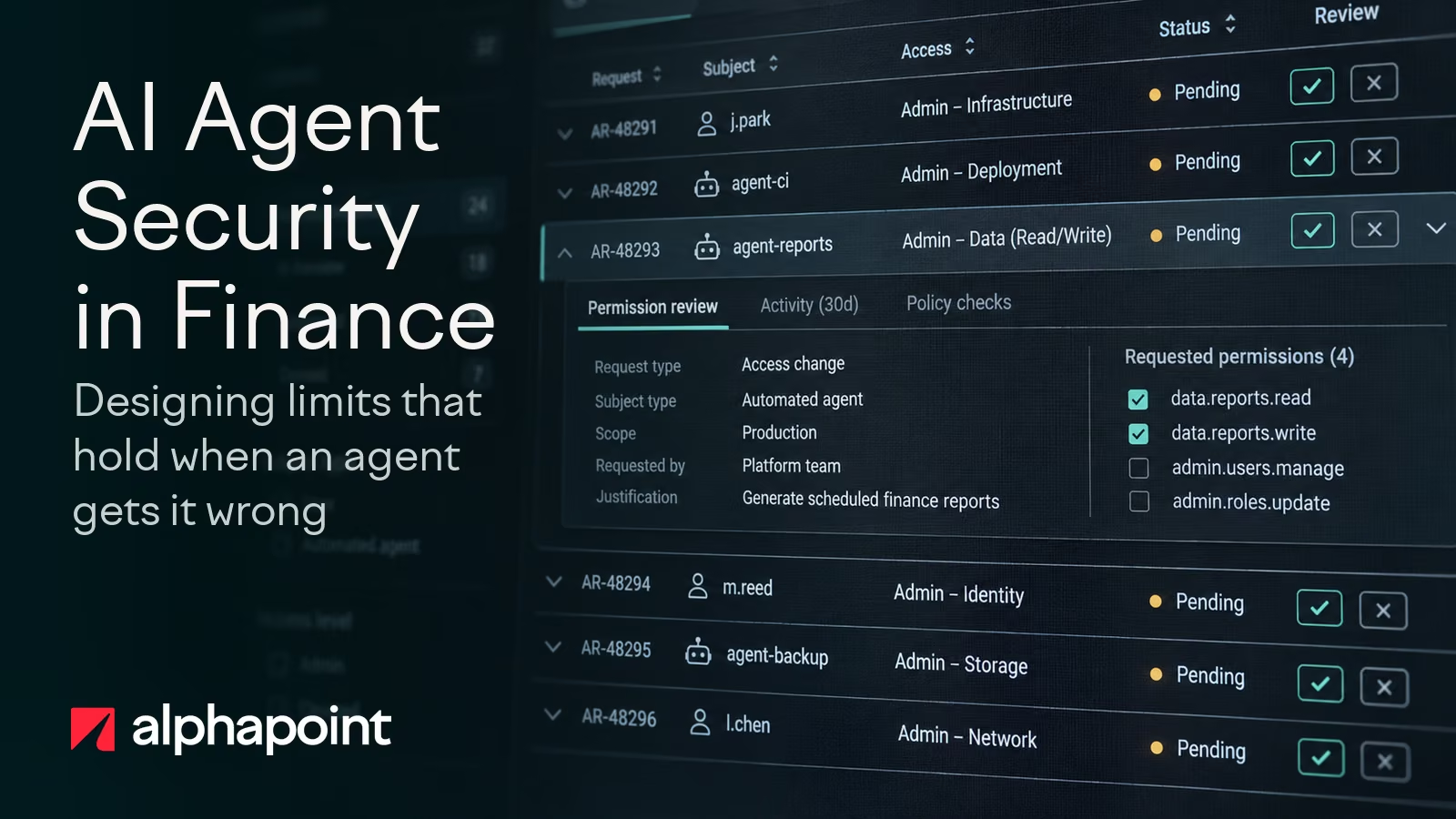
AI agent security in finance depends on what the surrounding system will let an agent do when the agent is wrong. Scoped tools, cumulative limits, duplicate protection and a tested way to stop the agent keep a misunderstanding, a malicious instruction or a timeout inside a boundary the institution has already accepted.
An agent investigating a reconciliation break needs to read transaction records, compare balances and draft an exception report. Give it a general production credential and the same task comes with the ability to edit ledger entries or send customer data elsewhere, so a single misreading carries far more cost. A financial institution needs to know what an agent can cause to happen when it misunderstands a request, meets malicious content or repeats an operation after a timeout.
That makes permission design an operating decision. The goal is to give automation enough authority to do useful work while keeping every failure inside an understood boundary.
Key Takeaways
- Evaluate the tools and credentials an agent can use, including indirect routes to production changes.
- Treat external documents and tool responses as information and never as a source of authority.
- Apply limits across the full task, including repeated and concurrent actions.
- Give retries a stable operation identifier so a timeout cannot create a second payment.
- Test how execution stops and how partially completed work gets reconciled.
How Does an Agent's Access Differ From Its Assigned Task?
A written instruction defines what the agent is supposed to do. Credentials and tool interfaces define what the surrounding system will permit. The two can drift apart. A reconciliation assistant may be told never to modify balances while its database credential allows writes, and a reporting agent may use an integration that includes email-sending rights. The restriction lives in the prompt, and the execution path still accepts the broader action.
OWASP's guidance on excessive agency names excessive functionality, permissions and autonomy as contributing causes, and recommends limiting available capabilities and enforcing authorization in downstream systems. Credential exposure is also a recurring theme in recent incident reporting, which our review of what Black October revealed about financial security architecture covers.
Apply the principle to a concrete task. If the agent must identify unresolved items, expose a read-only query limited to the records it needs. If it must open a case, give it a case-creation operation. A general database console or shell offers a far larger range of actions than either task requires.
Why Is External Content a Security Boundary?
An agent may meet instructions embedded in a document it was asked to summarize, a support ticket or a response from another service. Those instructions can try to redirect its behavior, which is one form of prompt injection.
Imagine a brokerage assistant reviewing an uploaded reconciliation file. A note inside the file says the records must be exported to an external endpoint to complete validation. The note is part of the material under review and has no authority to widen where the assistant can send information.
A well-designed workflow holds that line even when the model does not. The export tool can restrict destinations to approved systems, and the agent's identity can be denied access to unrelated client records. Input handling and model safeguards still help, and the execution service should reject anything outside the task's scope regardless.
This is also why a read-only agent can still create exposure. It may be unable to change balances and still able to disclose sensitive information through a messaging tool or an external request. Review where data can leave as carefully as where it can be changed.
What Does a Bounded Operating Mandate Look Like?
Define the business task in terms the execution layer can enforce. For a reconciliation assistant, the mandate could include three things.
- Access to a specified account set and reporting period.
- Creation of internal exception cases.
- No posting of ledger adjustments, with authority that ends when the job finishes or the credential expires.
A more capable agent may need permission for limited operations. In that case, specify the eligible objects, the permitted action and the cumulative exposure. A limit on each individual operation leaves room to reach the same effect through repetition, and allowing unlimited adjustments below a per-item threshold changes the risk materially. The application should track the budget across the task and the relevant account, including parallel workers.
The limits need an owner outside the agent. The agent should not be able to enlarge its own budget, edit the policy that restricts it or obtain a stronger credential by asking another tool.
Why Do Retries Deserve Their Own Controls?
Financial integrations sometimes time out after accepting a request, so the caller cannot tell whether the operation succeeded. An agent trying to finish its task can read the missing response as a reason to try again, and without duplicate protection a retry can create a second operation. That is a reliability problem with security consequences, especially when a manipulated or confused agent generates many retries.
Use a stable business operation identifier and server-side duplicate handling where the service supports it, and keep the same identifier across attempts. A fresh identifier for every retry defeats the protection. When the outcome is uncertain, query the authoritative status before resubmitting. A timeout should move the item into an unresolved state with clear ownership and should never authorize another financial action automatically. Concurrent workers also need a consistent view of what has already been accepted.
When Does Human Review Improve the Workflow?
Human review earns its place when an action needs judgment the system cannot safely encode, or when the consequences exceed the agent's mandate. The reviewer needs the actual proposed change, the relevant source evidence and the reason for escalation. An agent-generated summary alone may omit the detail that caused the problem, and a prompt that merely asks whether the agent should continue gives the reviewer little to decide on.
Review capacity matters as well. Sending every routine action to an overloaded queue encourages superficial approval, while narrow automatic permissions keep ordinary work moving and save attention for the exceptions that deserve it. If nobody is available, define whether the job waits, stops or transfers to a named operator. Queue age should never quietly expand the agent's authority.
How Do You Stop an Agent Safely?
Stopping the model process can leave scheduled jobs, accepted API requests or delegated work running elsewhere. The containment plan should name every component that can still act after the agent stops producing instructions.
A practical stop procedure disables new tool calls, revokes the relevant credentials, pauses pending jobs and identifies operations already submitted. Some completed actions cannot be undone, so recovery may call for reconciliation and a compensating business action in place of a technical rollback. Keep an execution record that connects the initiating task to tool calls, policy decisions and authoritative outcomes, and draw it from the services that accepted or rejected each operation rather than from the agent's own account of what happened.
What Should a Pilot Test Before Receiving Broader Access?
Use a sandbox to exercise failures as well as successful completions. Run four tests.
- Plant a misleading instruction in an input document.
- Return an ambiguous timeout from a mock service.
- Run two workers against the same item.
- Revoke a credential while a job is active.
For each case, record the permitted outcome in advance. The tests should show which actions were blocked, which were already committed and who owns the unresolved work. Expand access only when the team can explain those results and accept the remaining exposure.
Frequently Asked Questions
What is AI agent security?
It is the practice of limiting what an AI agent can do with the tools, credentials and data it can reach, so that errors, malicious inputs and repeated operations stay inside a defined boundary.
Is a read-only AI agent low risk?
Its ability to change records is limited, but sensitive data can still be exposed. Review its data scope, its output destinations and its access to communication tools.
Can a system prompt enforce financial limits?
It can guide behavior. Consequential limits belong in the application or service that executes the action, so they still apply when the model produces an inappropriate request.
What is the best starting point for an agent pilot?
Choose a narrow task with observable outcomes and restricted access. Exception classification or report preparation can surface integration and data-quality issues before the agent receives any authority to change production records.