BLOG ARTICLE
How CFOs Should Compare Stablecoin Treasury Pricing: Subscription Fees, Basis Points, FX Costs, and Banking Fees


A CFO evaluating stablecoin treasury vendors typically ends up with two or three proposals that don’t line up. One quotes a flat monthly subscription. Another leads with “no platform fee” and a percentage on every transaction. A third combines a subscription with basis points on top, plus separate charges for FX conversion, wire transfers, and implementation. None of these figures are comparable until they are tested against the same input, which means actual monthly volume, payment count, and how much of that volume converts between stablecoins and fiat. What follows is a framework for separating the real cost of a stablecoin treasury platform from its headline price, and the questions worth putting to any vendor before signing.
Why the headline fee isn’t the number that matters
The headline fee isn’t the number that matters because it’s only one variable in a pricing formula that usually includes several others, such as a percentage rate, a volume-based minimum, or a set of pass-through costs that don’t appear until the first invoice. Comparing subscription prices alone treats two structurally different pricing models as if they were the same product.
Two providers can advertise numbers that look directly comparable (“$500 a month” against “no monthly fee”) while landing at very different total costs once real volume runs through either model. The only reliable comparison models both proposals against the buyer’s own volume, not the vendor’s pricing page.
The cost components to separate in any quote
Before comparing two proposals, break each one into its component parts. Not every vendor itemizes all of these. The absence of a line item usually means it’s bundled somewhere else, not that it doesn’t exist.
- Subscription or platform fee. Fixed, tiered by included volume, or negotiated case by case.
- Included volume and overage. The threshold above which a higher tier or an overage rate applies.
- Basis-point or transaction fee. A percentage of volume moved, or a flat fee per transaction.
- Minimums. A monthly minimum charge regardless of actual usage.
- FX spread. The cost of converting between fiat currency and stablecoins.
- Banking fees. Wire and ACH charges on the fiat leg, whether charged by the platform or a banking partner.
- Network fees. On-chain settlement costs, sometimes absorbed by the vendor, sometimes passed through.
- Implementation charges. One-time integration cost, more common at enterprise scale.
- Third-party pass-through. Custody, liquidity sourcing, or KYC/wallet screening billed separately from the core platform fee.
- Support and enterprise pricing. SLA-backed support or dedicated account management priced above the base tier.
Why a low subscription with high basis points can cost more at volume
A low subscription fee paired with a high per-transaction rate can end up costing more than a higher subscription with a low transaction rate, once volume crosses a specific threshold. Percentage-based costs scale directly with volume; flat costs don’t.
Hypothetical example, for illustration only, not vendor or Alphapoint pricing. Provider A charges no subscription and 0.75% on volume moved. Provider B charges $2,000 a month plus 0.10% on volume moved.
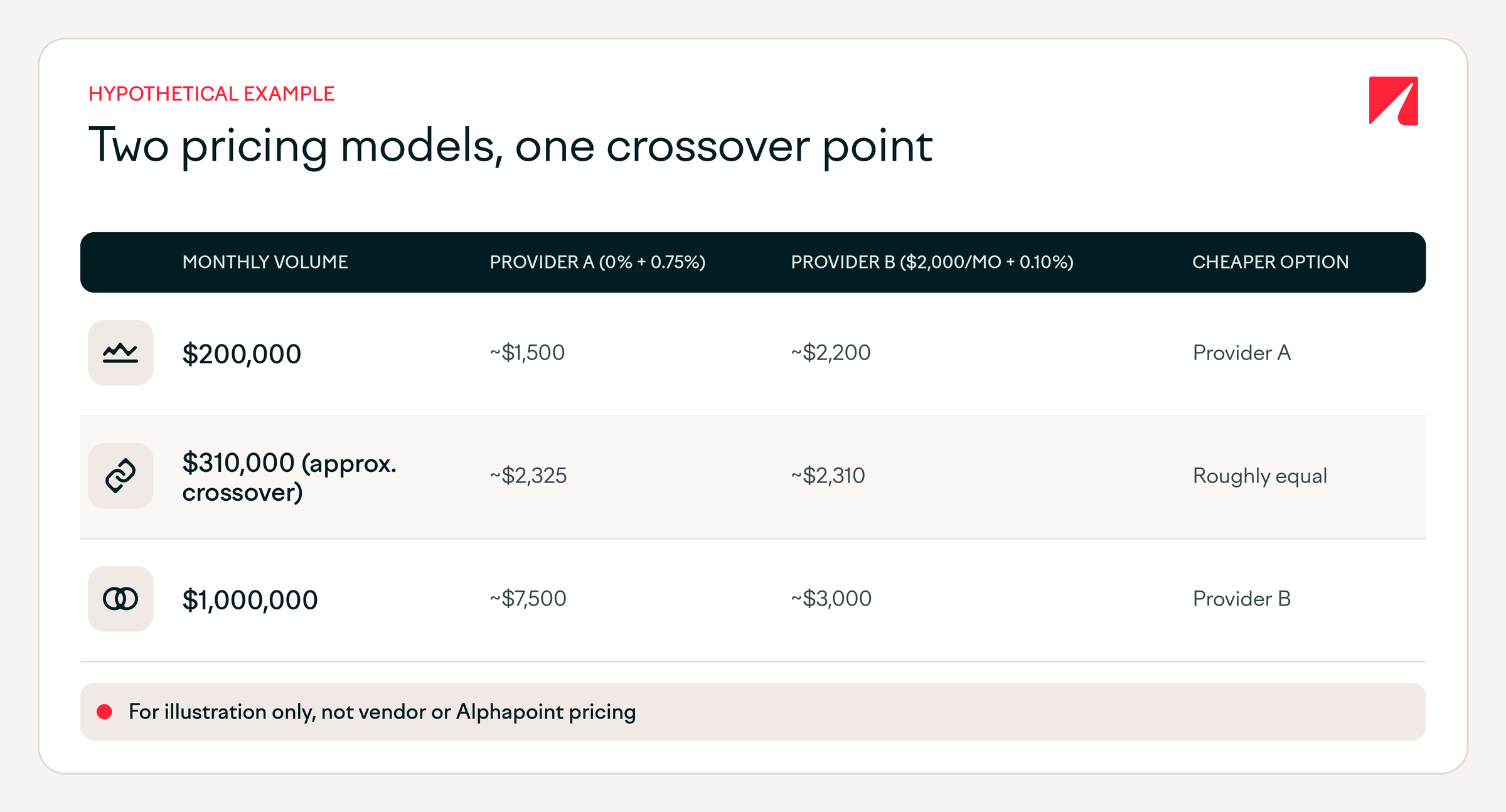
Hypothetical example for illustration only, not vendor or Alphapoint pricing.
The crossover point depends entirely on each vendor’s real rates, which is why it has to be calculated against your own volume rather than assumed from the headline numbers.
Percentage-only pricing does exist in the market, with no separate monthly subscription. It is a structure worth modeling explicitly against your own volume rather than assuming it’s cheaper because there’s no visible platform fee.
Costs that don’t disappear on a stablecoin platform
Moving to a stablecoin treasury platform doesn’t eliminate FX exposure, banking fees, or network costs. It changes where those costs sit and how they scale. An FX spread still applies on any leg that converts between fiat and stablecoins. Wire and ACH fees still apply to fiat deposits and withdrawals. On-chain network fees still apply to blockchain settlement, whether or not they’re itemized separately. A vendor’s flat monthly fee replaces the transaction-based pricing model, not every underlying cost behind it.
Questions to ask before signing
A useful vendor conversation is one where every answer produces a number, not a marketing claim.
- What is the all-in monthly cost at our current volume, and at twice that volume?
- Is the subscription tiered by included volume, and what’s the overage rate above it?
- Does the basis-point or transaction fee apply to gross volume, net volume, or only the fiat-conversion legs?
- Are FX spread and on/off-ramp costs included in the quoted rate, or itemized separately?
- Are banking fees charged by the platform, passed through from a banking partner, or excluded from the quote entirely?
- Is there a one-time implementation fee, and does it scale with integration complexity?
- Are custody, liquidity sourcing, and KYC/wallet screening bundled into the platform fee or billed separately?
- What does support cost above the base tier, and is dedicated account management a separate line item?
- Is pricing locked for the contract term, or can included volume, tiers, or rates change at renewal?
Comparing two vendor quotes on subscription price alone gives a CFO half the answer. The rest of the cost (basis points, FX spread, banking fees, and implementation) moves with volume and structure in ways a pricing page doesn’t show. Running any proposal against actual monthly volume and payment count, before signing, is what turns a marketing comparison into a procurement decision.
For a closer look at how flat-fee and percentage-based models compare across specific use cases such as cross-border payments, payouts, and mint and burn stablecoins, start with Alphapoint’s treasury fee savings simulator.