BLOG ARTICLE
What Black October 2026 revealed about financial security architecture

What was Black October?
Black October is a label security firms used for the cluster of incidents disclosed in October 2026. ScruteX applied it to 28 separate incidents disclosed or updated during the month, with ten surfacing on October 20 and 21. Wiz used it for a concentrated wave against AI developer platforms.
It was not one coordinated attack. The actors, methods, and timelines differed. That is why it matters. Unrelated attackers kept getting through the same architectural assumptions.
The incidents that matter for financial operations
Binance, October 29. Reuters reported that attackers compromised transaction-signing infrastructure. Binance's first account pointed to a compromised engineer's laptop and internal systems used to process withdrawals, with roughly $6.3 billion in assets reached, among the largest crypto thefts on record. Binance said it found no evidence that private keys were exposed, and it later said it had found additional points of breach beyond the first. Bitcoin Magazine reported that the FBI attributed the attack to North Korea, that Binance had replaced 95 percent of the stolen assets by November 1, and that Tether and Circle froze about $1.57 billion in USDT and more than $800 million in USDC. A full post-mortem has not been published.
Mercado Bitcoin, November 2. Bitcoin Magazine reported that Brazil's largest crypto exchange kept deposits and withdrawals suspended after a security incident. The company said it had identified and contained the incident, that customers suffered no losses, and that no data leaked. According to Bloomberg, it said it would absorb all losses. It has not said which system was breached, how much was taken, or when it will reopen. Hypernative's preliminary estimate put suspicious transfers above $40 million across several blockchains, which the exchange has not confirmed, and Tether said it froze more than 4.5 million USDT linked to the incident. It came days after the Binance theft, so it sits just outside the October count, and the cause has not been disclosed.
CERT-In and CSIRT-Fin, October 9 and November 4. India's national agency warned that attackers were compromising applications and privileged endpoints, stealing payment or bank API credentials, and then calling fund-transfer APIs from inside the victim's own whitelisted infrastructure. That path bypassed application-level checks such as KYC, sanctions screening, beneficiary verification, balances, and transaction limits. On November 4 the agency named the campaign CRAFTY FALCON and described an AI-assisted actor operating at machine speed against fintechs, payment providers, lenders, and digital asset firms.
AI developer platforms. Wiz identified at least nine platforms hit in October, including Railway and Fireworks AI. The target was stored environment variables and credentials, especially AI-provider keys. Railway said attackers may have accessed decrypted secrets and advised customers to rotate stored keys. Zeabur reported that a breach on October 14 and 15 exposed records for 321,810 accounts and about 3.2 million environment-variable records, and that credentials missed in an earlier cleanup remained usable. Fireworks confirmed that unauthorized use of internal credentials exposed environment variables in a limited number of accounts. Wiz then saw stolen enterprise AI credentials tested within 30 minutes. In one case an attacker made roughly 800,000 calls over 30 hours.
LiteLLM. A malicious release in the software supply chain stole cloud, database, and AI credentials, and CERT-In issued an advisory on the compromised packages.
ConnectWise cloud backup. Kudelski Security reported that a compromised vendor-held credential was used to obtain Microsoft Graph tokens across customer tenants, and ConnectWise suspended several connected services. Microsoft separately documented AI-assisted attacks against hundreds of organizations, including abuse of compromised supplier application credentials, with some reaching privileged cloud access in under three hours.
eMudhra. Eight intermediate certificate authority keys were found to be cryptographically weak, and the company revoked them.
Each item reflects public reporting or vendor disclosure at the time of writing. Details may change as investigations continue.
Three failure patterns underneath
Reusable secrets became executable authority. Credentials stored beside the software that uses them are available to anyone who controls that software. Railway and Fireworks AI show what that costs.
Valid access was not the same as authorized action. In the CERT-In cases and in the Binance reporting, the attacker did not need to defeat every control. Legitimate credentials or infrastructure were enough to make legitimate systems do something nobody approved.
Trusted channels and speed. LiteLLM, ConnectWise, and eMudhra all sat inside the trust boundary. AI-assisted attackers then moved faster than any human review could.
The architecture tie-in
If the application cannot be the last line of defense, something has to sit around the operation itself. That control boundary has to do five things, in order, before anything irreversible happens.
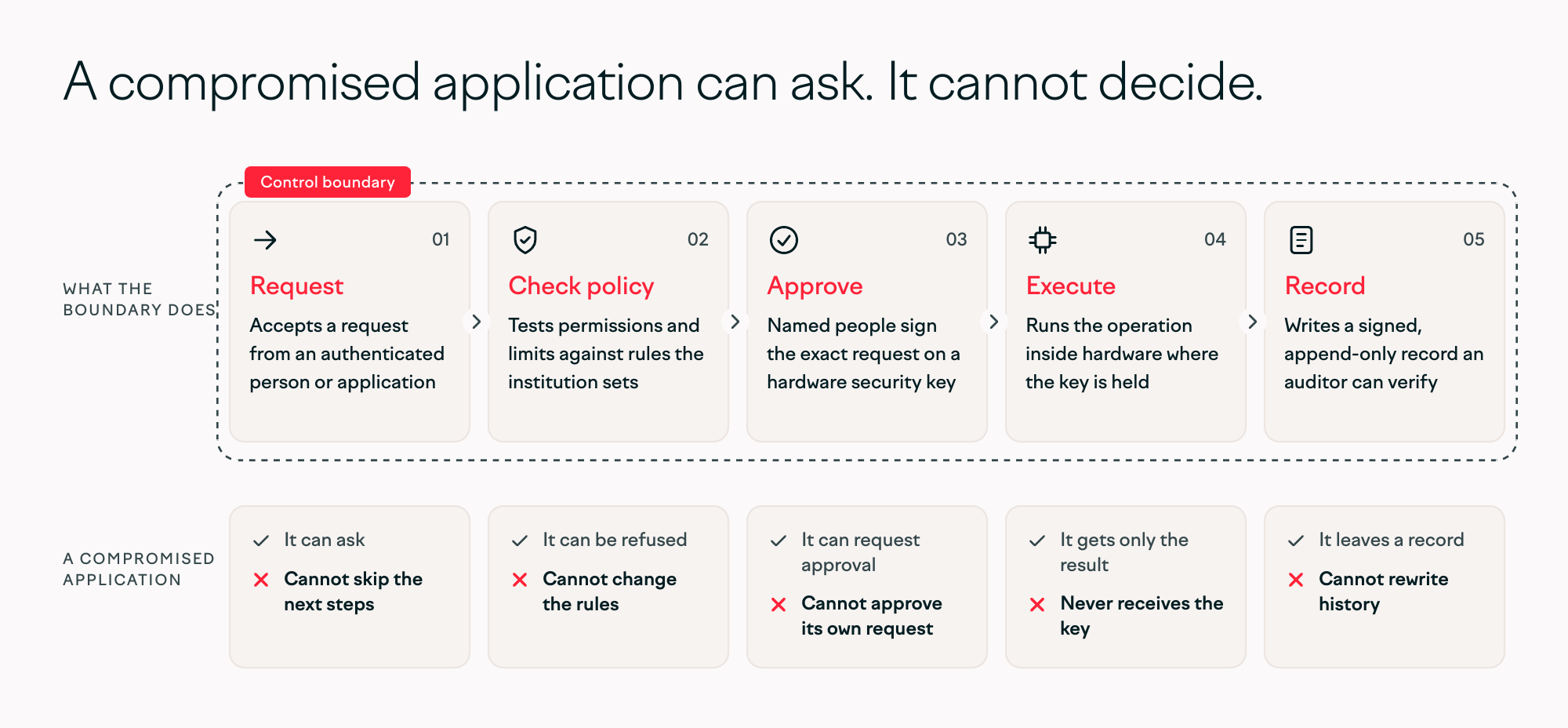
Two more properties close gaps that October exposed.
Limit where a compromised system can send things. Several incidents involved credentials used from inside trusted infrastructure. In AlphaPoint Cloud, a network boundary called NETBREAK sits in front of every instance. Inbound traffic comes only from the control plane's authenticated sessions, and outbound traffic only answers to them, so a program inside has nowhere to send what it finds.
Make updates verifiable and reversible. Compromised releases were a recurring entry point. Cloud uses signed software updates, tries each release on a machine, requires it to confirm its own health, and returns to the last good version if it fails.
The point is not that any one product would have changed the outcome of a specific incident, and no architecture makes compromise impossible. Policies can be too loose, approvers can sign without reading, and endpoint, network, and monitoring controls still matter. The goal is to change what a compromise is worth, so that reaching one application is not enough to move money.
What to check this week
- Which secrets sit in environment variables, configuration stores, or build systems that a host can read?
- Do any of those credentials never expire?
- Does a person approve the exact transaction, shown from the transaction itself?
- Can one credential, person, or system satisfy an approval alone?
- Can a compromised system send data anywhere it chooses?
Every no or not sure is an authority path worth closing.
Frequently asked questions
Was Black October a single cyberattack?
No. ScruteX counted 28 separate incidents in October 2026, and Wiz used the same label for a wave against AI developer platforms. The causes and actors differed.
Why do stolen API credentials matter so much to financial institutions?
A valid credential can call a fund-transfer API from a trusted position and bypass application-level checks. The control that matters is whether the exact action was approved by the people who are meant to approve it.
What is a control boundary in financial infrastructure?
It is a layer around a critical operation that checks policy, requires approval of the exact request, executes inside protected hardware, and records the result, so a request from any one application is not enough on its own.
See it on your own workflow
Our engineers run a 90-minute security briefing under NDA, covering the architecture, threat model, and evidence behind AlphaPoint Cloud.