10 Ways Security Token Offerings Improve the Traditional Securitization Process
By Patrick Shields | Published March 20, 2019 | Updated Mar 31, 2026
If you’ve been following the blockchain industry, you may have noticed a wave of news about security token offerings (STOs), tokenization, or tokenized assets in the past year. When this article was first published in 2019, preliminary data from Autonomous Next indicated that 87 institutions were on track to raise $562 million by issuing shares via security tokens.
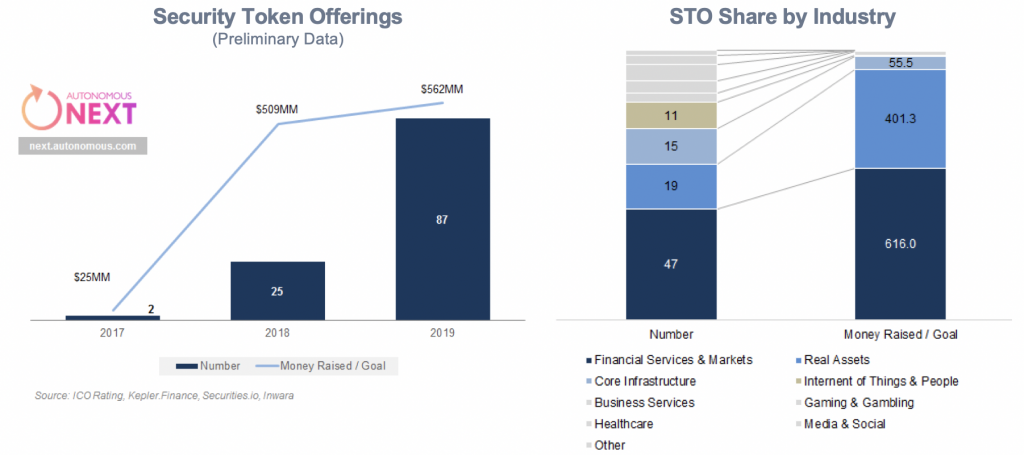
Source: Autonomous Next
The security token and real-world asset (RWA) tokenization market has grown dramatically since 2019. According to data from RWA.xyz, on-chain tokenized RWAs (excluding stablecoins) grew ~85% year-over-year to reach $15.2 billion by December 2024 and surged to approximately $18.6 billion by the end of 2025. Including stablecoins, the broader tokenized market reached over $217 billion. McKinsey & Company projects the tokenized asset market (excluding stablecoins and CBDCs) could reach $2 trillion by 2030 in its base case, with an optimistic scenario of $4 trillion. Standard Chartered’s projection is even more ambitious, estimating the market could reach $30 trillion by 2034. Over 200 institutional RWA projects are now underway, supported by more than 40 leading financial institutions, including BlackRock, Fidelity, Franklin Templeton, and J.P. Morgan.
What Is a Security Token Offering? (Definition and How It Works)
A security token offering (STO) is the process of issuing a new digital asset that represents a traditional security, such as equity, debt, or a real asset, to a group of investors on a blockchain or distributed ledger. Unlike utility tokens or cryptocurrencies, security tokens are explicitly tied to real-world financial rights and fall under securities regulations in the jurisdiction where they are issued.
To understand STOs fully, a few foundational definitions are helpful:
Tokenization: The act of representing an asset, such as a financial product, physical asset, ownership stake, or legal right, on a blockchain or distributed ledger system.
Smart Contract: The unique programmable code on a blockchain system that represents the digital asset. Within that smart contract, issuers can assign specific data or attributes, link documents, enforce compliance rules, and enable automated business logic.
Security Token Offering (STO): The act of issuing a new digital asset that represents a traditional security, such as equity, debt, a real estate interest, or a fund share, to investors via blockchain infrastructure.
Several naming conventions have emerged in the industry, digital securities, tokenized assets, security tokens, securitized tokens, but in the context of traditional securitization, these terms all refer to the age-old process of issuing, distributing, managing, and trading both financial and physical assets on modern blockchain infrastructure.
What constitutes a security depends on the jurisdiction. Common asset classes represented via security token offerings include:
Financial Assets:
- Debt and Derivatives: Bonds, Mortgages, Derivative Securities, Loans
- Equity and Funds: Private Company Shares, Fund Interest, Project Finance, Trusts, Real Estate Investment Trusts (REIT)
Physical Assets:
- Exclusive Assets / Luxury Goods (e.g., Diamonds, Gold)
- Commodities
- Real Estate
Securitization vs. Tokenization: The Key Differences
While tokenization and traditional securitization both aim to convert assets into tradeable instruments, they differ significantly in mechanics, cost structure, and investor reach. The table below outlines the key distinctions:
| Traditional Securitization | Blockchain Tokenization (STOs) |
|---|---|
| Compliance enforced at the exchange level | Compliance programmed directly into the token (smart contract) |
| Settlement typically takes T+2 business days | Near-instant (T+0) settlement via on-chain rails |
| High administrative, legal, and audit overhead | Reduced overhead through automation and shared ledger |
| Liquidity limited to single exchange pool | Multi-exchange liquidity; fractional ownership possible |
| Investor reach constrained by geography and minimums | Global investor access; fractional ownership lowers minimums |
| Audit trail maintained by intermediaries | Immutable, real-time audit record on blockchain |
Types of Security Tokens—With Real-World Examples
Security tokens span multiple asset classes. Understanding the different types helps financial institutions, asset managers, and investors identify the right issuance structure:
- Equity Security Token Offering: Represents ownership in a company or fund. Example: tokenized private company shares that grant economic rights (dividends, voting) and are traded on alternative trading systems.
- Debt / Bond Security Token Offering: Represents a loan or bond obligation. Example: tokenized corporate bonds that automate coupon payments via smart contract. Broadridge’s DLR platform now facilitates over $1 trillion monthly in tokenized repurchase agreements.
- Real Estate Security Token Offering: Represents fractional ownership in property or real estate funds. Example: tokenized REIT shares or direct property tokens that enable smaller investors to access commercial real estate. (See dedicated section below.)
- Asset-Backed Security Tokens: Backed by physical commodities such as gold, diamonds, or oil reserves. Tokenization provides clear provenance to underlying asset value and enables real-time redemption.
Fund Interest Tokens: Represent shares in hedge funds, private equity, or infrastructure funds. BlackRock’s BUIDL fund, the largest tokenized treasury fund, grew from $40 million at launch in March 2024 to over $1.8 billion by late 2025.
Why Blockchain-Based Tokenization Improves Traditional Securitization
Blockchain and distributed ledger technologies have three distinct features that significantly improve financial market infrastructures by reducing overhead cost, creating operational efficiencies, and enhancing liquidity.
Blockchain technology enables issuers, operators, and investors to:
1. Program specific rights and restrictions for each unique digital asset: This is accomplished through a smart contract, in which rights and restrictions are managed and enforced by being programmed into each token. By contrast, with traditional technology implementations, these rights and restrictions are managed and enforced by an exchange.
2. Execute trades between two digital assets in near-real time, without the use of an escrow service: The security and interaction of a blockchain system enable two parties to exchange value directly. As an example, two parties can each hold a digital asset (one representing $1 USD and one representing 1 share of a private equity fund) and exchange them in near-real-time on-chain.
3. Maintain a complete audit record for each token transaction: Each event, asset transfer, and trade is recorded on the blockchain in a secure system that can be queried at any point to provide real-time information. Moreover, the data, documents, and information about the digital asset live with it through its lifecycle, in a centrally available system of record.
How Does a Security Token Offering Work? (The STO Process)
Understanding how to execute a security token offering requires navigating legal structuring, blockchain infrastructure, and investor onboarding. The process typically unfolds in five stages:
1. Asset Structuring and Legal Wrap: The issuer defines the asset type (equity, debt, real estate, fund), determines the jurisdiction, and prepares the legal documentation required for compliance. Securities regulations (such as Regulation D or Regulation S in the US, or MiCA in the EU) govern what types of investors can participate and under what conditions.
2. Token Design and Smart Contract Deployment: A smart contract is created on the chosen blockchain network. The contract encodes compliance rules (e.g., investor whitelist, holding periods, transfer restrictions), economic rights (dividends, voting), and any other deal-specific terms. This is the defining advantage of a security token offering over a traditional issuance: compliance is embedded at the asset level, not the exchange level.
3. Primary Issuance: Tokens are created and distributed to approved investors’ digital wallets. The blockchain provides an immutable record of initial ownership from day one, reducing the need for traditional transfer agents and paper-based registers.
4. Investor Onboarding (KYC/AML): Investors complete identity verification and accreditation checks. Once whitelisted, they can receive and hold the security token. This process can be significantly faster and cheaper than traditional onboarding for alternative investments.
5. Secondary Trading and Lifecycle Management: Once the lock-up period expires (if applicable), tokens can be traded on authorized secondary markets, alternative trading systems (ATS) or licensed digital exchanges. Smart contracts continue to enforce compliance rules during all secondary transfers, automating activities such as dividend distributions, interest payments, and corporate action notifications.
10 Ways Security Token Offerings Improve Traditional Securitization
In the context of the securitization lifecycle, the following benefits alleviate inherent inefficiencies in capital allocation, illiquidity, and operational procedures:
Primary Issuance
1. Compliance and Flexibility
Securities created via smart contracts enable flexible, programmable compliance at the asset level, rather than at the exchange level. This ensures restrictions directly related to the deal structure, such as a whitelist for accredited investors, a cap on the number of investors, or a restricted holding period, are encoded in the security itself and enforced throughout the life of the token.
This programmable compliance architecture is equally powerful for equity security token offerings, debt security token offerings, and bond token offerings. Rather than relying on custodians or exchanges to police transfer restrictions, the token itself rejects non-compliant transactions in real time. As global frameworks such as MiCA (EU) and the GENIUS Act (US) provide clearer regulatory pathways for digital securities, technology-enabled securitization compliance is becoming a competitive differentiator for issuers.
2. Lower Administrative Costs
The share creation and distribution processes are simplified by creating tokens directly to the appropriate account and distributing them to investors on the blockchain. Over time, this reduces overhead audit, legal, and technology costs.
As McKinsey notes, immutable data on a shared ledger reduces the data errors associated with manual reconciliation, one of the most labor-intensive aspects of conventional securitization. In blockchain-enabled lending specifically, McKinsey highlights that smart-contract-enabled calculations of payouts and streamlined reporting materially reduce required cost and labor throughout the credit lifecycle. For private credit issuers, tokenized securitization can shorten time-to-capital while reducing the operational overhead of managing a distributed investor register.
3. Clear Provenance to Underlying Asset Value
Tokenization reduces counterparty risk and directly ties token value to associated financial or physical products. The on-chain record of ownership and asset linkage provides investors with transparent, verifiable provenance that traditional securitization vehicles typically cannot match.
Secondary Trading
4. More Liquidity – Including in Real Estate
Compliance at the asset level instead of the exchange level means that investors, issuers, and operators are not locked into a single pool of liquidity. With the opportunity to access multiple exchanges, the lack of price discovery and illiquidity discount typically associated with private securitized assets can be reduced and/or eliminated over time.
Security token liquidity is already proven at institutional scale. Broadridge’s Distributed Ledger Repo (DLR) platform now facilitates over $1 trillion in tokenized repurchase agreements monthly, demonstrating real-time blockchain settlement is no longer theoretical. The liquidity unlock is particularly transformative for historically illiquid asset classes:
- Real Estate: BCG estimates the real estate tokenization market will grow from ~$120 billion in 2023 to $3.2 trillion by 2030 (a ~49% CAGR). Deloitte projects tokenized private real estate funds alone could reach $1 trillion by 2035, approximately 8.5% of total real estate assets under management.
- Private Credit: Private credit is now the largest on-chain RWA segment, accounting for approximately 61% of tokenized real-world assets as of 2025, according to RWA.xyz data.
- Bonds and Treasury Debt: Tokenized US Treasury products surpassed $7.4 billion by mid-2025, up approximately 80% year-to-date.
5. Real-Time Settlement
Coupled with on-chain payment rails, either currency-pegged stablecoins or cryptocurrencies, trades benefit from near-real-time settlement, greatly reducing operational costs of exchanges and contributing to investor liquidity.
Traditional financial settlements occur two business days after the trade is executed (T+2), giving each party time to arrange documentation and funds. McKinsey notes that instant settlement enabled by tokenization ‘could translate to significant savings for financial firms in high-interest-rate environments.’ BlackRock’s BUIDL fund, launched in March 2024 on Ethereum, became a live proof point, growing from $40 million at launch to over $1.8 billion by late 2025, demonstrating institutional appetite for tokenized, 24/7 tradeable financial instruments.
Lifecycle Management
6. Efficiency
With a real-time ledger of asset ownership available, coupled with on-chain payment rails, management activities such as dividend distributions, profit-sharing, buybacks, and remittances can become automated and highly efficient. Smart contracts execute corporate actions based on pre-defined conditions without manual intervention, reducing errors and processing delays.
7. Investor Reach
Without burdensome overhead and with lifecycle processing simplified, it becomes much easier for an asset manager to reach a larger investor base. Fractional ownership, made possible by dividing a single asset into many tokens, dramatically lowers investment minimums. A real estate fund that previously required a $1 million minimum can, via tokenization, accept investments as low as $1,000, unlocking a global retail and institutional audience previously excluded from private markets.
Security Token Offerings in Real Estate: A Special Case
Among all asset classes, real estate security token offerings represent one of the most compelling applications of digital securitization. Traditional real estate investment involves high transaction costs, illiquid exit options, and minimum investment sizes that exclude most investors. The digital securitization of real estate assets via blockchain addresses all three constraints simultaneously.
→ Case Study: Learn how Alphapoint helped Elevated Return tokenized $1B of real estate
How real estate security token offerings work in practice:
- A property or portfolio is legally structured into a special purpose vehicle (SPV) or REIT-equivalent.
- Tokens representing fractional ownership are issued on a blockchain, each token conferring economic rights (rental income, appreciation) and, optionally, governance rights.
- Investors purchase tokens through a compliant primary offering, with KYC/AML built into the onboarding flow.
- Secondary trading occurs on licensed digital securities exchanges or ATS platforms, providing exit liquidity, a feature typically unavailable in traditional private real estate funds before their fund term ends.
The data supports growing institutional conviction:
- BCG projects the global real estate tokenization market will grow from ~$120 billion in 2023 to $3.2 trillion by 2030, a ~49% annual growth rate.
- Deloitte projects that tokenized private real estate funds alone could reach $1 trillion by 2035, approximately 8.5% of total real estate AUM.
- As of mid-2024, nearly 12% of global real estate companies had already adopted tokenization, while 46% were in the pilot phase.
- Dubai’s Land Department forecasts the real estate tokenization market in Dubai alone could reach $16.3 billion by 2033, representing 7% of total real estate transactions.
Asset tokenization and trading generates meaningful benefits for issuers, broker-dealers, and investors alike, access to more capital, enhanced liquidity, faster onboarding, more efficient processes, real-time settlement, and streamlined compliance. In future posts in this series, we will discuss security token market trends and provide deeper overviews of creating and managing security tokens for specific asset classes.
Frequently Asked Questions About Security Token Offerings
What is a security token offering (STO)?
A security token offering (STO) is a fundraising mechanism in which a company or asset manager issues digital tokens on a blockchain that represent traditional securities, such as equity shares, bonds, real estate interests, or fund units. Unlike an initial coin offering (ICO), an STO is explicitly subject to securities regulations, meaning tokens are issued to verified, compliant investors in accordance with the applicable legal framework (e.g., Reg D / Reg S in the US, MiCA in the EU).
How does a security token offering work?
An STO typically follows five stages: (1) legal structuring of the asset, (2) smart contract creation and token design, (3) primary issuance to accredited investors, (4) KYC/AML-gated investor onboarding, and (5) secondary trading on licensed digital exchanges or ATS platforms. At each stage, compliance rules are enforced automatically by the smart contract rather than relying on a centralized exchange to police transfers.
What are examples of security tokens?
Real-world examples of security tokens span multiple asset classes:
- Tokenized US Treasury funds: BlackRock’s BUIDL fund surpassed $1.8 billion AUM by late 2025.
- Tokenized repurchase agreements: Broadridge’s DLR platform processes over $1 trillion monthly.
- Tokenized real estate: Fractional property tokens enabling retail participation in commercial real estate portfolios.
- Tokenized private credit: The largest on-chain RWA segment as of 2025, representing ~61% of the on-chain market.
- Tokenized gold and commodities: Asset-backed tokens tied to physical bullion bars or commodity reserves.
What is the difference between securitization and tokenization?
Traditional securitization converts illiquid assets into tradeable securities through intermediaries (SPVs, transfer agents, exchanges), with compliance managed at the exchange level and settlement taking T+2. Tokenization achieves the same economic outcome on a blockchain, encoding compliance rules directly into the token, enabling near-instant settlement, reducing administrative costs, and making fractional ownership possible, all without requiring all parties to rely on a single centralized exchange.
How does tokenization improve security and compliance?
Tokenization improves security and compliance in several ways: (1) compliance rules (investor whitelist, transfer restrictions, holding periods) are embedded directly in the smart contract and enforced automatically, (2) every transaction is immutably recorded on the blockchain, providing an always-current audit trail, and (3) the token’s provenance, its link to the underlying asset, is verifiable and tamper-resistant from issuance through the entire asset lifecycle.
What is security token liquidity, and why does it matter?
Security token liquidity refers to the ease with which a security token can be bought or sold in a secondary market. Traditional private securities suffer from illiquidity discounts because they are locked to a single exchange or investor group. Security tokens, with compliance enforced at the asset level, can trade across multiple authorized venues globally, unlocking liquidity for historically illiquid assets like private equity, private credit, and real estate. Improved liquidity benefits both investors (easier exit) and issuers (potentially lower cost of capital).
How do I invest in security tokens?
Investing in security tokens typically requires: (1) completing a KYC/AML verification and, in many jurisdictions, meeting accredited investor criteria, (2) setting up a compatible digital wallet, (3) accessing a licensed primary offering platform or secondary trading exchange that lists the specific security token. As regulatory frameworks mature (MiCA in the EU, the GENIUS Act in the US), more compliant on-ramps for both institutional and retail investors are expected to emerge.
What is a real estate security token offering?
A real estate security token offering (real estate STO) is the process of issuing blockchain-based tokens that represent fractional ownership in a property, real estate fund, or REIT-equivalent vehicle. Each token grants the holder economic rights, such as a share of rental income or capital appreciation, and can be traded on secondary markets, providing liquidity that traditional real estate investments rarely offer. BCG projects the global real estate tokenization market to reach $3.2 trillion by 2030.