BLOG ARTICLE
How the Approval Device Works: Nine Real-World Use Cases Beyond Finance

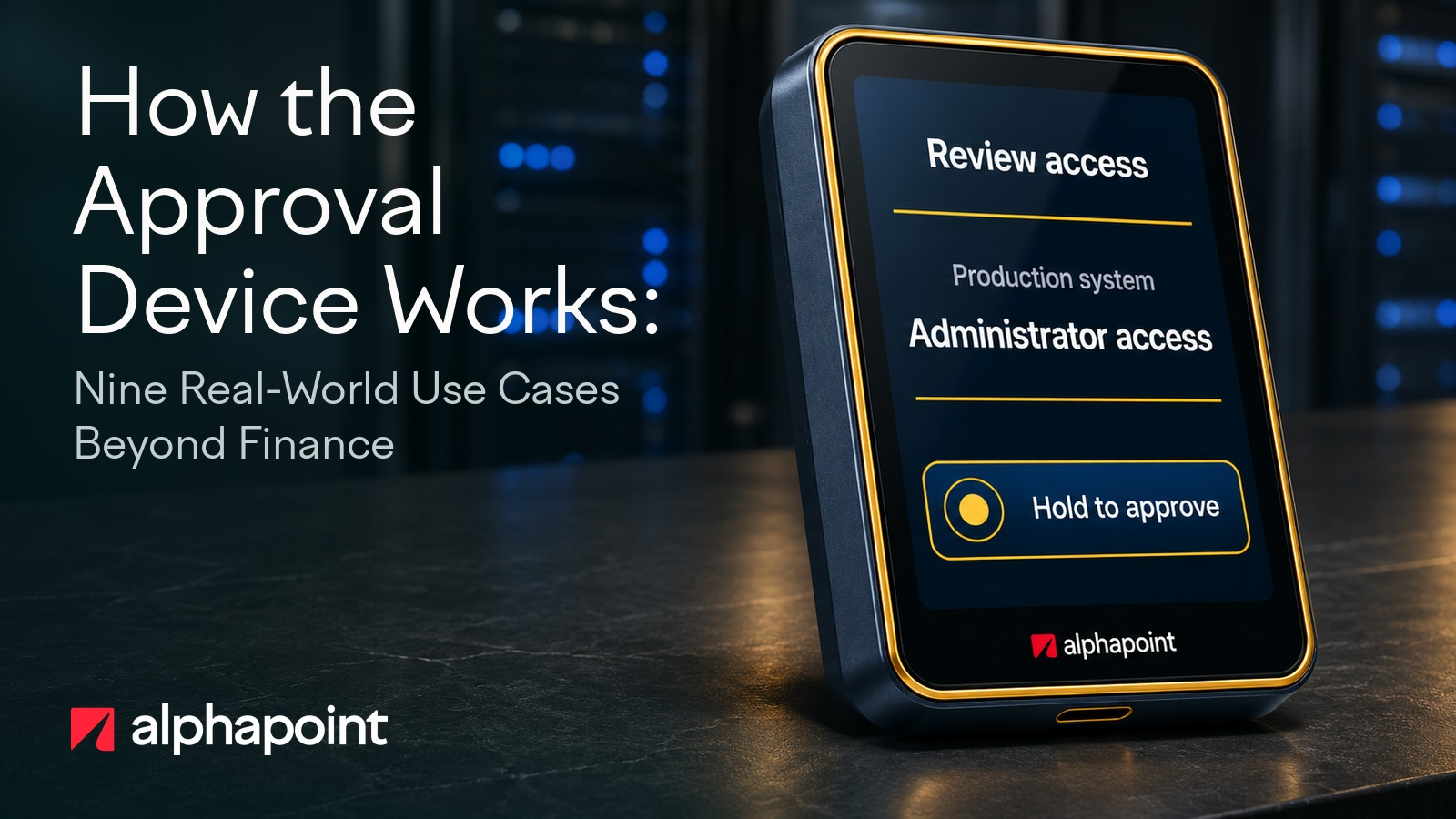
AlphaPoint’s Approval Device is a security approval device that lets an authorized person review the exact details of a high-risk action, such as a payment, a permission change or a data export, on a dedicated screen before anything is released. A secure core then checks that the action matches the approved request, the organization’s policies and its required approvals. The pairing applies wherever one wrong approval is expensive to undo, which includes finance and extends well beyond it.
Picture an ordinary working day. A merchant asks to settle funds to a wallet that was added an hour ago. An administrator is asked to grant production access for a weekend change. A support lead needs to send a customer export to an outside provider. Each request looks routine, each is easy to approve in a hurry, and each is hard to reverse once it goes through. The use cases below show how the Approval Device and a secure core handle moments like these.
Key Takeaways
- The Approval Device shows the person approving the specific details of an action, such as the destination, amount, scope or permission change.
- A secure core checks the action against policies, limits and required approvals before the connected system can execute it.
- The same approval pattern fits nine types of organization, from payment processors and exchanges to cloud operations teams and backup administrators.
- The strongest candidates are actions that are high in value, difficult to reverse, or likely to be changed shortly before execution.
- Retaining a signed decision record gives security and audit teams a clear account of who approved what, and when.
What is the Approval Device?
The Approval Device is a dedicated device that shows an approver the details of a specific action and records their decision. The aim is for the person to approve what will actually happen, not a summary shown by the system that made the request. The details that matter usually answer the same questions. Who is asking, where is something going, what is it, how much, and how does it differ from the last approved instruction?
How does the approval process work?
Whatever the industry, the flow is consistent.
- A request is created in the connected system, such as a payments platform, an exchange back office or an IT admin console.
- The relevant details of the request are presented to the approver on the Approval Device.
- The approver reviews those details and approves or rejects the action.
- The secure core checks the action against destination rules, limits, policies and required approvals, and confirms it matches what was approved.
- If the checks pass, the connected system can proceed, and the decision can be kept as a signed record.
Where is the Approval Device used in the real world?
The pattern is the same across industries, while the details that matter change. The list below gives a representative situation for each of nine types of organization, and the sections after it cover what the approver reviews and what the secure core is intended to check.
- Payment processors. A merchant requests settlement to a newly added wallet.
- Exchanges and wallet platforms. An operations team replenishes an operational wallet or manually releases an exceptional withdrawal.
- Market makers and trading firms. A trading desk moves collateral between venues or changes an OTC settlement destination.
- Institutional brokers. A counterparty amends settlement instructions shortly before funds are due to move.
- Yield and tokenization platforms. An operator authorizes a vault allocation, investor distribution, redemption or token issuance.
- Staking infrastructure providers. An authorized team approves a staking instruction or changes an operational permission.
- Enterprise IT and cloud operations. An administrator grants production access or changes a critical system setting.
- Businesses handling sensitive data. A support or HR team exports customer or employee records to an external provider.
- Infrastructure and recovery teams. An administrator requests deletion of a backup or a reduction in retention.
How do payment, exchange and trading firms use approvals?
A payment processor receives a request to settle a merchant’s balance to a newly added wallet. The approver sees the merchant’s identity, the destination, the asset and the amount. The secure core checks destination rules, limits and required approvals before settlement instructions are released.
On an exchange or wallet platform, the moment is often an operations team replenishing an operational wallet or manually releasing an exceptional withdrawal. The approver sees the source account, destination, asset, amount and the reason the transfer needs additional review. The secure core verifies that the transfer matches the approved request and satisfies withdrawal or treasury policies.
A trading desk might move collateral between venues or change an OTC settlement destination. Here the approver needs the counterparty and any changes to established instructions, along with the destination, asset and amount. The secure core enforces transfer limits and verifies the outgoing operation against approved instructions.
Institutional brokers face a familiar pressure point when a counterparty amends settlement instructions shortly before funds are due to move. Changes made close to the time of payment leave little room for second thoughts, which is why the approver sees the original and proposed settlement details side by side, along with the recipient and amount. The secure core requires approval for changed instructions and retains a signed decision record.
How do yield, tokenization and staking platforms use approvals?
On a yield or tokenization platform, an operator may authorize a vault allocation, an investor distribution, a redemption or a token issuance. The approver reviews the relevant vault or asset, the action, the amount or quantity, the recipient and any restrictions. The secure core checks policies and required approvals before permitting execution through the integrated system.
Staking infrastructure providers have a similar need. An authorized team approves a staking instruction or changes an operational permission, and the approver sees the network, validator and amount, or the precise permission change. The secure core protects the authorization logic and enforces approval requirements where the organization controls the action.
Where do approvals matter beyond finance?
The same logic protects any system where a single approval can change what is possible next. An administrator in enterprise IT or cloud operations might grant production access or change a critical system setting. The approver sees the account, the requested permissions, the affected environment, the duration and the proposed change, and the secure core checks that the integrated system executes only the authorized change.
Businesses that handle sensitive data face it when a support or HR team exports customer or employee records to an external provider. The approver reviews the dataset, the scope, the recipient and the destination. The secure core enforces access and export policies and binds the approved scope to the release, so the export that leaves is the export that was approved.
Infrastructure and recovery teams meet it when an administrator requests deletion of a backup or a reduction in retention. Backups are the last line of recovery, so a change here deserves the scrutiny of a payment. The approver sees the affected backup and the proposed change with its scope, and the secure core requires designated approvals before the connected system applies the change.
What should the approver be able to see?
Across all nine cases, the approver reviews the same few things. Who or what is affected, where it is going, what it is, how much of it, and how it differs from the established instruction. If the approver cannot see the destination, scope or change, the approval becomes a formality. If they can, it becomes a real control. For a closer look at what an approval should prove, see what a digital asset transaction approval should prove.
What does the secure core check?
The secure core sits between the approval and the execution. It checks destination rules, limits and required approvals, and verifies that the operation matches the approved request. It binds the approved scope to the release, so the connected system can only carry out what was authorized. When instructions change, it requires a fresh approval, and it can retain a signed record of each decision.
Where should an organization start?
Start with the actions that combine high impact with low reversibility. In finance that is usually a change of destination, a manual release or an amended settlement instruction. In IT and data operations it tends to be production access grants, bulk exports and the deletion of backups. For each candidate, write down what the approver must see, which rules the secure core should enforce and who is allowed to approve, then test the workflow with a realistic request.
Alphapoint works with organizations as a design partner on the infrastructure around security-critical operations. For teams mapping approval workflows around the Approval Device, that conversation can begin with the action that would be hardest to undo. Talk with the Alphapoint team about approval controls for your operations.
Frequently Asked Questions
What is a security approval device?
A dedicated device that shows an authorized person the exact details of a high-risk action, such as a payment, permission change or data export, and records their decision before a connected system can execute it. Alphapoint’s Approval Device is a security approval device.
How is the Approval Device different from approving on the screen where the request was made?
The requesting screen is controlled by the same system that created the request. The Approval Device is designed to show the approver the details of the action itself, so the decision rests on what will actually be executed.
Does the Approval Device only apply to crypto and finance?
No. Any organization where a single approval can move funds, grant access, release data or remove recovery options can use the same pattern. The examples above include IT administration, sensitive data exports and backup deletion.
What does a secure core do after an approval?
It checks the action against destination rules, limits, policies and required approvals, verifies that it matches the approved request, and can retain a signed record of the decision.
What happens if instructions change after approval?
A changed instruction needs its own approval, with the original and proposed details shown side by side so the approver can see exactly what moved.
Which actions should require the Approval Device first?
Actions that are high in value, hard to reverse or often altered shortly before execution, such as new payout destinations, production access grants, bulk data exports and backup deletion.