BLOG ARTICLE
What a Digital Asset Transaction Approval Should Prove

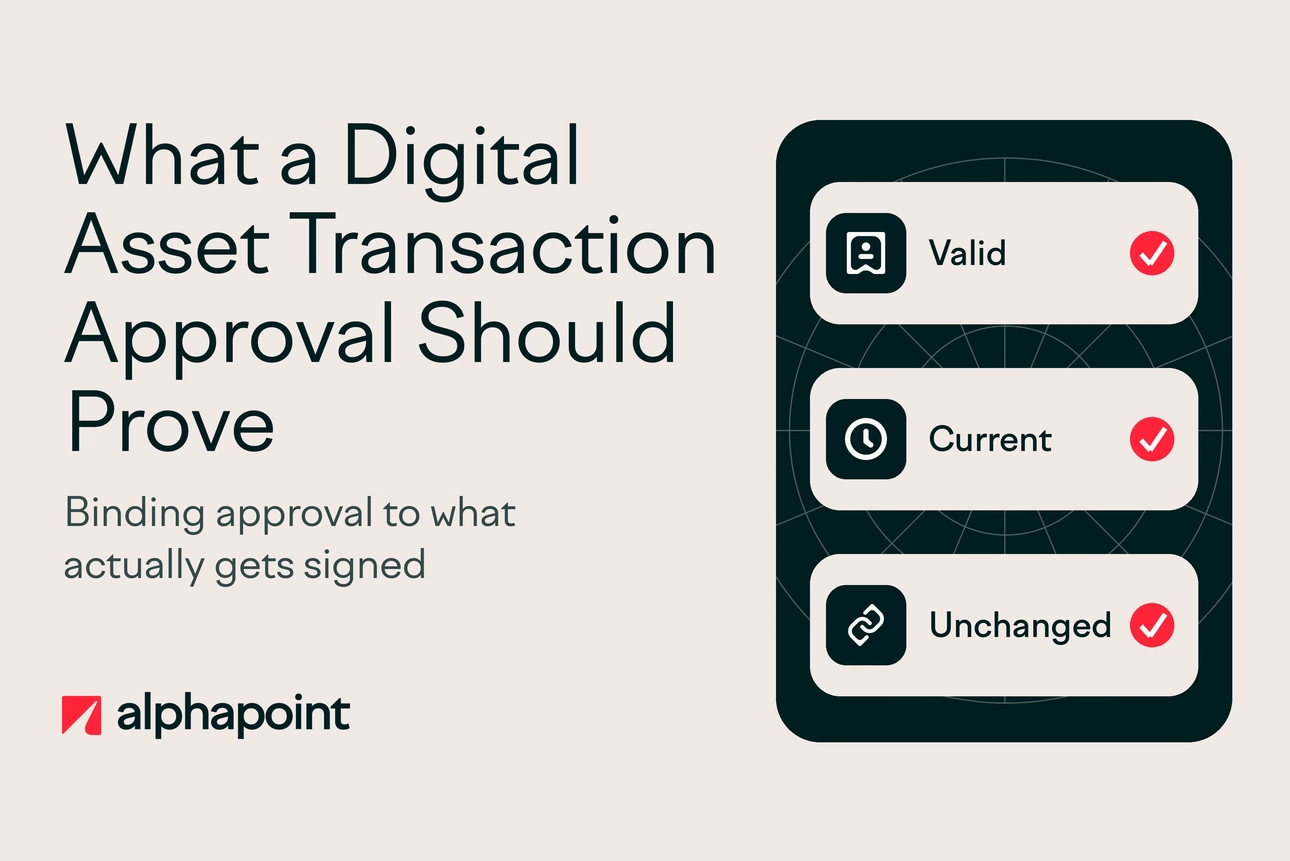
A digital asset transaction approval should prove that an authorized person approved the specific action that was signed. For a stablecoin payment, that means the recipient, asset, amount and network. For a smart contract call, it also means the contract, the function being invoked and the permissions that call grants.
If the signing service cannot establish that connection, an approval record may tell an investigator who clicked a button and leave the most important question unanswered.
That distinction deserves attention after the October 29 Binance incident. In its November 3 initial update, Binance said approximately $6.34 billion in digital assets were impacted and that it had strengthened device and wallet-service controls. Reuters subsequently reported that U.S. bank supervisors had asked banks about unusual activity and service disruptions. Separately, Crédit Mutuel Arkéa disclosed fraudulent transactions and a temporary pause in some operations, and said customer holdings were unaffected.
The disclosures describe different incidents, but they put the same question in front of institutions that move funds through a mix of internal applications, signing services and external providers. See the Binance incident update, Reuters on the supervisory response and the Crédit Mutuel Arkéa statement.
Key Takeaways
- An approval should cover the transaction fields that matter, not only a request ID.
- Dual approval helps only when the second person can independently verify what is being authorized.
- The signer is the last point where an institution can enforce its own policy before funds leave its control.
- Decide in advance which changes require a new approval, and make those bounds enforceable at signing time.
- Evidence should be verifiable without relying only on the dashboard that displayed the original approval.
Where Can a Transaction Approval Lose Its Meaning?
A treasury analyst enters a payment in a finance application. A controller approves it. A wallet service builds the transaction and sends it to a signing service. Each step can produce a record, but the records are only as useful as the links between them.
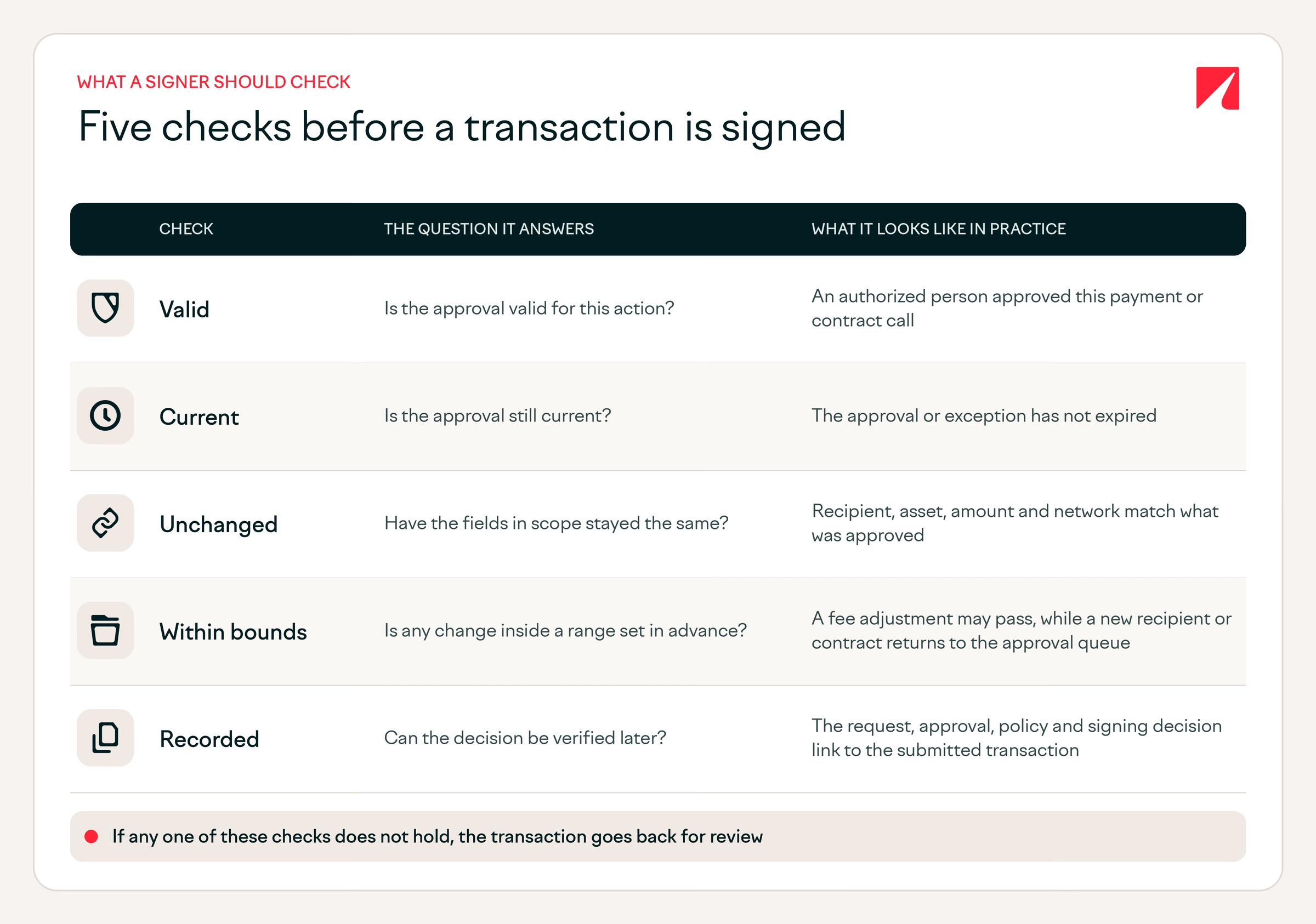
Consider an approved $250,000 USDC payment. If the beneficiary record changes before signing, the same payment request ID could still appear in the finance application even though the destination has changed. If the approval covers only that request ID, the signer has no way to tell whether the new destination was part of the decision. A control that binds approval to the authorized transaction fields can reject the mismatch and send the payment back for review.
Dual approval helps when the second person can independently verify what is being authorized. Giving two people the same incomplete description still leaves both of them working from incomplete information. The same principle applies to exceptions. A beneficiary change, a temporary limit increase or an emergency override deserves its own record, with an accountable approver and a clear expiry. Our guide to stablecoin treasury permissions covers the business roles that sit around those decisions.
What Should the Signer Be Able to Check?
The signer is the final point at which an institution can enforce its own policy before a transaction leaves its control. At that point, it should be able to check that the approval is valid for this action, that it is still current and that the transaction fields within its scope have not changed. The relevant fields vary by workflow, because a payment is different from a contract interaction or a change to the policy that governs future payments.
Decide in advance which changes require a new approval. A fee adjustment might be permitted within a defined range, while a new recipient or contract would return the transaction to the approval queue. For a recurring payout, a bounded authorization may cover a named recipient, a maximum amount and a time window. Those bounds need to be enforceable at signing time.
Key isolation addresses a separate problem. It reduces exposure of signing material. The approval check governs what the signing service will sign, including when a request arrives from an otherwise trusted application. Both controls matter to a bank evaluating a custody or wallet provider.
What Evidence Should an Institution Be Able to Verify Independently?
A transaction hash helps an investigator find what reached a blockchain. It typically does not identify the employee who approved it, the version of the policy in force or the exception that allowed it through. Those facts belong in an operating record that links the request, approval and signing decision to the submitted transaction.
Ask whether that record can be exported and verified without relying solely on the dashboard that displayed the original approval. An investigator should be able to match the authorized fields to the signed transaction and determine which policy was applied. Document how records from external custody, payment and settlement providers join that evidence trail, especially where different teams control the systems. ESMA’s July supervisory initiative on custody resilience names both transaction controls and third-party dependencies among the areas it will examine. Read the ESMA custody resilience initiative.
What Test Should You Bring to a Provider Review?
In a test environment, run this exercise with the provider.
- Approve a payment, then change its beneficiary before signing.
- Ask the provider to show the resulting decision, the record an investigator would receive and the steps required to get a corrected payment approved.
- Repeat the exercise with an expired approval, then with an exception that has timed out.
The result should show where the policy is enforced and which system can prove it.
Alphapoint works with institutions as a design partner on security-critical workflows, from defining approval requirements to reviewing how signing decisions and records can be verified. Explore Alphapoint’s approach to security-critical operations.
Frequently Asked Questions
What should a digital asset transaction approval prove?
That an authorized person approved the specific action that was signed, including the fields in scope such as the recipient, asset, amount and network.
Why is a payment request ID not enough?
If the beneficiary changes before signing, the request ID can stay the same while the destination changes. An approval that covers only the ID cannot tell the signer whether the change was part of the decision.
Does key isolation replace an approval check?
No. Key isolation reduces exposure of signing material, while the approval check governs what the signing service will sign, including requests from an otherwise trusted application.