BLOG ARTICLE
Self-Serve or Enterprise Stablecoin Treasury: Which Onboarding Path Fits Your Transaction Volume?

A payment service provider moving $600K a month in stablecoins can be signed up, verified, and live on a treasury platform before their compliance team finishes lunch. A regional bank moving $40M a month cannot, and trying to force that same instant-signup path onto a regulated institution wouldn't make onboarding better, it would just skip the diligence a bank's own risk committee requires. The real question isn't which onboarding path is faster. It's which one matches your volume, entity type, and compliance position.
Two different problems dressed up as one decision
Treasury and payments teams evaluating stablecoin infrastructure tend to hit one of two frustrations. Smaller PSPs and fintechs get funneled into enterprise sales cycles, discovery calls, procurement forms, multi-week technical evaluations, for what should have been a same-day signup.
Meanwhile, regional banks and larger institutions get pointed at a self-serve form that has no field for their KYB structure, their board-level compliance sign-off, or their multi-entity account architecture. Both outcomes waste time. The fix is matching the onboarding motion to the profile before you start, not after you've already lost two weeks.
How Alphapoint Treasury splits the two paths
Alphapoint Treasury ships in three pricing tiers, and those tiers map to two distinct onboarding motions rather than three.
Self-serve (Base tier). Built for SMBs, startups, and low-volume international payments. You register directly through the platform, verify your work email, set up MFA, and move into a KYB/KYC wizard: entity details and document upload (ownership and control structure, certificate of good standing, proof of address), followed by UBO identification and verification for anyone holding 10%+ ownership. Once KYB and KYC clear, the system automatically activates the company, provisions your Alphapoint ledger, and generates deposit addresses across all supported networks , no rep, no call, no integration engineering required to get started.
Sales-assisted (Pro and Enterprise tiers). Pro serves mid-market PSPs, growing fintechs, and smaller regional banks; Enterprise serves large institutions, regional and national banks, and tokenization platform builds running higher-volume treasury operations. Both route through discovery rather than a signup form, because at this size, the open questions aren't about entering a company name, they're about jurisdiction, existing TMS integration points, non-custodial vs. custodial architecture, and internal compliance sign-off.
What the numbers actually look like
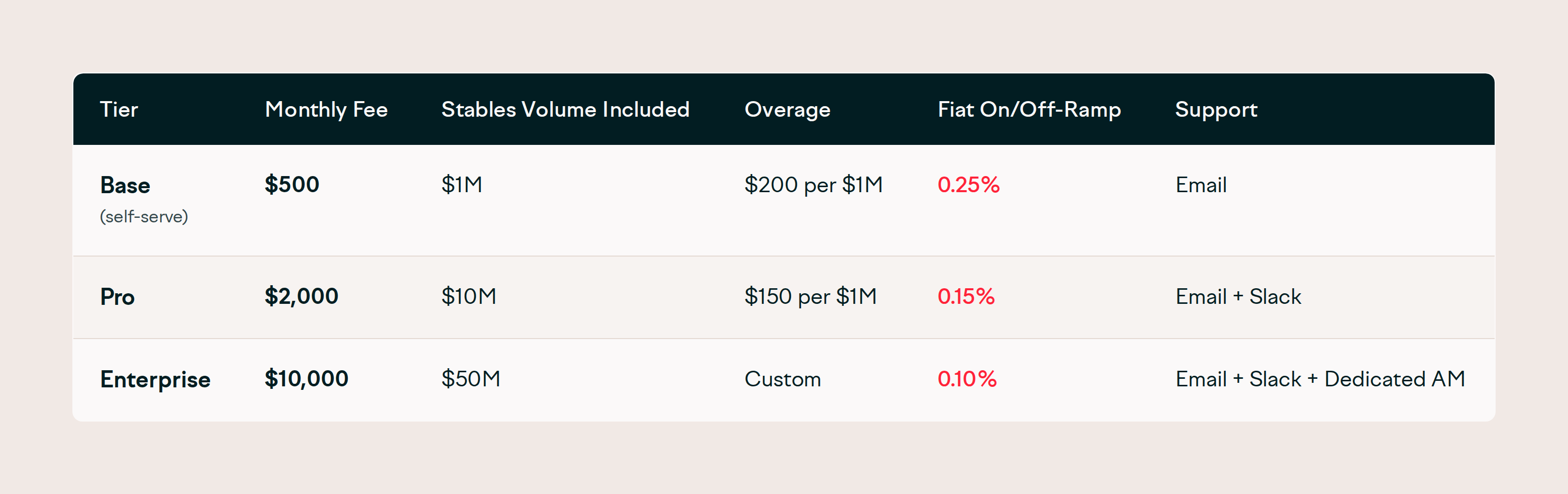
The pattern to notice: as included volume scales up, both the overage rate and the fiat ramp fee scale down. That's deliberate , it's a flat-fee SaaS structure rather than a purely percentage-based one, which matters once you're comparing it against retail processors. Coinbase Commerce, for comparison, charges a flat 1% on every transaction with no monthly platform fee at all , a fine model at low volume, but one where cost climbs linearly with volume rather than plateauing the way a tiered flat fee does.
A rough volume-based way to think about it
- Under $1M/month in stablecoin volume: self-serve almost always makes sense. You don't need a sales conversation to answer "can I use this," you need the fastest path to a working ledger.
- $1M–$10M/month, or a smaller regional bank piloting the category: this is Pro tier, sales-assisted rather than self-serve, because at this volume the beneficiary/payee limits, Slack-based support, and lower ramp fees start to matter more than instant signup speed.
- $10M–$50M+/month, or any regulated institution treating this as core infrastructure rather than a tool: Enterprise, full stop, regardless of whether volume alone would technically fit a lower tier. Institutions in this bracket need a compliance and technical review scoped to their specific jurisdiction and architecture requirements before go-live, not after.
That last point tracks broader industry data: institutions generally find dedicated treasury infrastructure cost-effective once they clear roughly $5M in monthly stablecoin volume, which is also where the operational case for structured onboarding (rather than a generic form) starts to outweigh the appeal of speed.
What to actually expect from a demo
A sales-assisted conversation isn't a generic product walkthrough. Expect it to cover: your current volume and the trigger behind exploring stablecoin infrastructure now (a client asking for it, a TMS that can't handle on-chain assets, a regulatory deadline); your jurisdiction and existing KYB provider, since integration accommodates what you already run rather than replacing it outright; whether you need non-custodial or custodial architecture; and a working timeline , target go-live, who owns technical evaluation, and when a compliance questionnaire is due. You should leave with a concrete plan, not a follow-up email promising one.
A quick illustration
Picture a mid-market PSP moving roughly $6M a month in stablecoin volume across a handful of corridors. Too large for Base tier's $1M included volume and beneficiary caps, not yet at the scale where a fully custom Enterprise build makes sense. That's the Pro-tier profile exactly: a short, single-buyer sales conversation focused on volume headroom and Slack-level support, not a multi-stakeholder compliance review.
Where to start
If you're under $1M a month in stablecoin volume, you can start today , the self-serve path is built for exactly that. If you're moving more, or you're a regulated institution evaluating this as infrastructure rather than a point tool, a conversation scoped to your volume and compliance profile is the faster route, even though it doesn't start with a signup button.
Start your treasury operations here or contact our team of experts.