BLOG ARTICLE
Trust Under Test, Rails Under Construction. Binance’s hack rattles markets as payment networks and DTCC build onchain.


Binance's $6.3 Billion Hack Exposes Exchange Control Risks
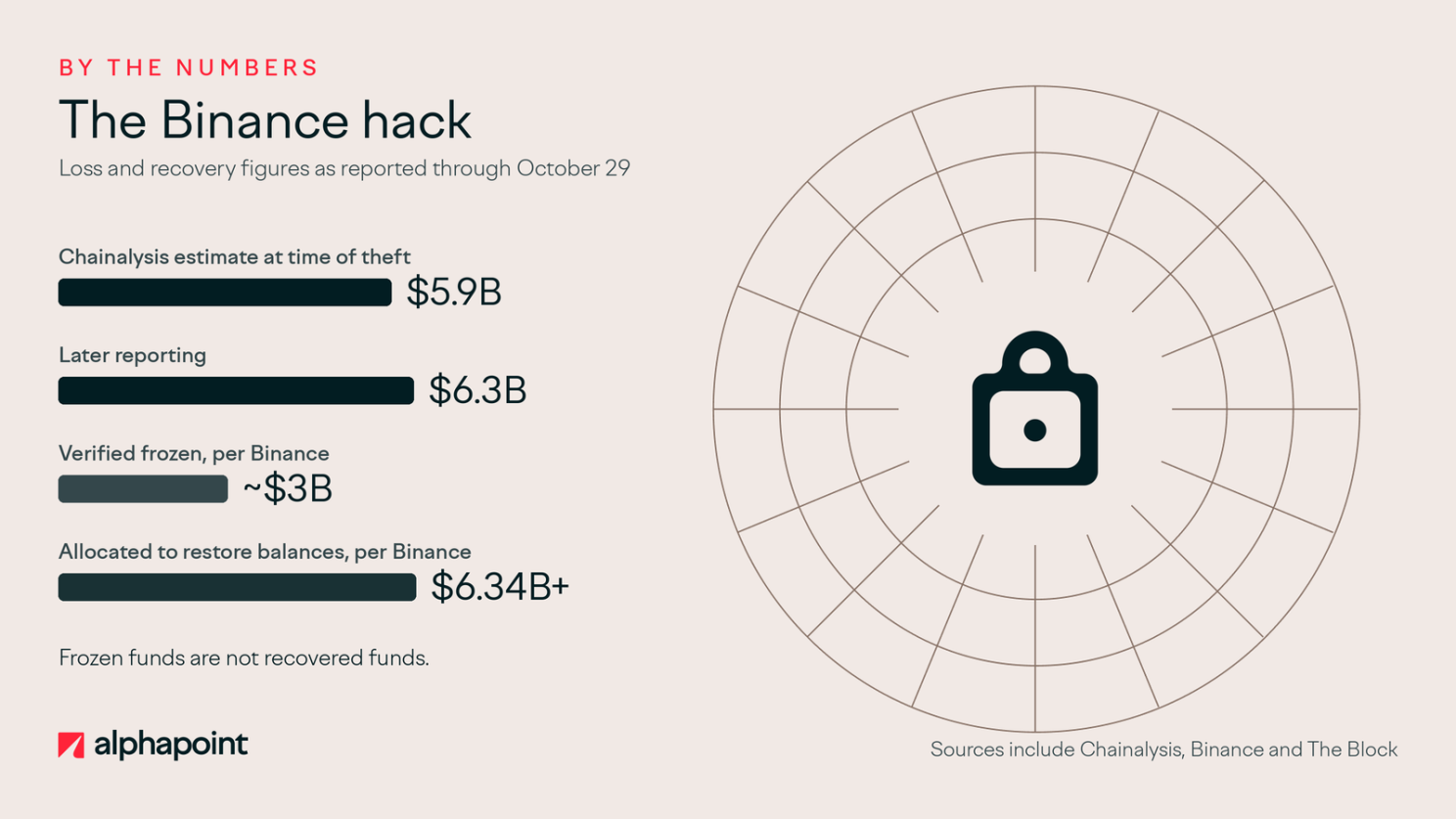
Binance, the world's largest cryptocurrency exchange, suffered a hack on October 29 that has been estimated at about $6.3 billion in stolen assets, which would make it the largest publicly reported crypto exchange theft on record. Estimates vary. Chainalysis estimated roughly $5.9 billion was stolen at the time of the theft, according to The Block, and later reporting put the figure at $6.3 billion. Binance said the currently verified frozen amount is around $3 billion, with help from blockchain networks and stablecoin issuers including Tether and Circle. Frozen funds are not recovered funds, and public reporting had not established that the assets had been returned to Binance.
Binance's preliminary investigation traced the incident to a potentially compromised DevOps engineer's laptop that enabled unauthorized withdrawal requests through its service infrastructure. The exchange initially reported no evidence of private key leakage, though later reporting indicated that investigators had identified additional possible points of compromise. Blockchain intelligence firms linked the attack with high confidence to North Korea-associated activity, although Binance had not officially identified the perpetrators.
Co-CEO Yi He said Binance will cover all user losses. The exchange said it would use its SAFU reserve and corporate resources, and in a later update said it had allocated over $6.34 billion to restore balances. Coinbase CEO Brian Armstrong said Coinbase was doing everything it could to support the response, including blocking transfers to compromised wallets.
Bitcoin fell below $79,000 during the first news cycle and below $77,000 late Thursday, trading at $76,664 as of 10 p.m. ET, down 4.5% over 24 hours, according to The Block. BNB lost 7.1% to $698.65, Ether fell 5.2% to $2,190 and XRP fell 7% to $1.21. CoinGlass data showed $1.55 billion in liquidations over 24 hours across 246,482 traders, including $1.34 billion in long positions. The largest single liquidation order was $11.09 million on Binance's BTCUSDT market.
Analysts differed on the fallout. Zeus Research's Dominick John said the exploit intensified selling, with BNB facing the greatest exposure, and that recovery hinges on Binance restoring confidence in exchange security and customer funds. Laevitas' Rick Maeda called the reaction fairly contained, citing Binance's $144 billion in assets under custody and swift moves by Tether and Circle to freeze more than $2.4 billion. ViaBTC's Jeff Ko said he does not expect the stolen bitcoin to add much selling pressure and believes Binance can absorb the loss.
The preliminary findings point to questions beyond key custody, including transaction authorization, administrative access, withdrawal policies and the separation of critical systems. The rapid freezing of stablecoins also highlights a structural difference between issuer-controlled digital dollars and assets such as bitcoin and ether, whose transfers generally cannot be reversed or frozen by an issuer.
Bitcoin ETFs Return to Inflows While Ether Redemptions Continue
According to Farside Investors, U.S. spot Bitcoin ETFs recorded four consecutive sessions of inflows from October 26 through 29, after an outflow of $137.9 million on October 23. Net flows for the period were $302.9 million. Ether ETFs moved the other way, losing capital on every trading day from October 26 through 29, for net outflows of $271.3 million over the period.
Momentum faded on October 29, the day of the Binance hack. Bitcoin inflows slowed to $17.2 million from $137.3 million the previous day, while Ether redemptions accelerated to $105.5 million. Positive Bitcoin flows should not be read as broad institutional demand across digital assets, and the continuing Ether withdrawals contrast with corporate ETH treasury accumulation and staking strategies.

The Fed Holds Rates With Two Dissents Favoring a Hike
The Federal Reserve held its benchmark rate at 3.75% to 4.00% on October 28, voting 10 to 2 to maintain the range, according to Reuters. Governor Lisa Cook and Cleveland Fed President Beth Hammack dissented, preferring a 25 basis point increase. The FOMC upgraded its description of economic growth from solid to strong while reiterating that inflation remains elevated. Chair Kevin Warsh avoided committing to a December increase, but markets read the decision as leaving further tightening on the table.
The S&P 500 rose 0.28% and the Nasdaq Composite rose 0.27% on October 28, and bitcoin initially climbed toward $81,000. Bond markets continued repricing the possibility of another increase in December. The limited immediate reaction suggests the decision was largely anticipated, and the larger question is whether persistent inflation and elevated funding costs constrain institutional allocations, leverage and trading activity through the end of 2026.
Robinhood's Crypto Business Shifts From Trading Toward Infrastructure
Robinhood reported third-quarter revenue of $1.42 billion on October 27, a slight earnings miss, and its shares fell about 10% in the hours after the release. Crypto revenue fell 55% from a year earlier to $120 million. Robinhood Chain, released in July, contributed $26 million of net revenue in its first quarter on mainnet, and excluding it crypto revenue fell 6% from the second quarter to $94 million. Prediction markets generated $173 million in quarterly revenue, and Bernstein noted that non-sports contracts doubled their share to about 30%, led by crypto, commodities and financial contracts.
Analysts looked past the miss. StoneX's Mark Palmer said an unrealized loss on Robinhood Ventures Fund I reduced earnings per share by $0.07, and that excluding it and other items, earnings per share came in $0.60 above consensus. StoneX kept a buy rating and a $170 price target. Bernstein, led by Gautam Chhugani, kept an outperform rating and a $160 target, and said the crypto business is shifting from retail trading into an infrastructure business. It expects prediction markets, perpetual futures and Robinhood Chain to generate about 25% of revenue by 2028.
Bernstein attributed lower revenue per dollar of crypto activity mostly to growth in Robinhood Earn, its stablecoin product, which now holds more than $500 million in assets and earns less than trading. Excluding Earn, revenue per dollar traded was roughly unchanged from the prior quarter.
Tokenized Equities Split Between Institutional Rails and Open Markets
Four different approaches to tokenized securities are emerging, with important differences in issuance, liquidity, custody and issuer participation.
DTCC launched its tokenization service on October 28 on Canton Network and its private Besu blockchain, initially supporting selected U.S. equities, ETFs and Treasuries. Eligible institutions can tokenize securities held at the Depository Trust Company and transfer those representations between approved blockchain wallets around the clock, while official ownership records remain with DTC. Twenty institutions have signed agreements to access the service, including Morgan Stanley, JPMorgan, Citi, Bank of America, Barclays, Fidelity and Citadel Securities. CoinDesk reported 34 eligible securities representing $30 trillion in market value, a figure that measures the eligible securities and not the volume already tokenized. Morgan Stanley separately expects to support tokenized equities on its alternative trading system in the first quarter of 2027.
Coinbase-issued tokenized equities exceeded $4 billion in cumulative decentralized exchange trading volume since their August 24 launch on Base, Crypto Briefing reported on October 29. The tokens are issued under Base's B20 standard and backed one-for-one by shares held with a regulated custodian. Trading has been concentrated on Aerodrome, and more than $260 million worth of tokenized assets has reportedly entered lending protocols such as Aave. Onchain research by Bitquery found that three clusters of trading wallets accounted for 67% of measured trading in a September to October sample, raising the question of how concentrated liquidity provision remains.
The OKXICE venture, backed by OKX and NYSE parent Intercontinental Exchange, has met resistance from listed companies. CoinDesk reported 38 disclosed objections as of October 29, including 30 from the original 62-company roster as of the October 28 reporting. JPMorgan, Coca-Cola, Dell, Walmart and Eli Lilly are among the objectors. The SEC's innovation exemption creates a pathway for qualifying tokenized equity trading but requires notice to issuers and an opportunity to object. The planned venue would support stablecoin-settled, round-the-clock trading using automated market-maker infrastructure.
In the United Kingdom, LSEG announced plans with Kraken parent Payward in September for tokenized UK shares on a new venue planned for 2027, subject to approval. The Wall Street Journal had earlier reported issuer concerns about liquidity, pricing and market structure.
The technology for around-the-clock tokenized trading is progressing faster than consensus on how the securities should be issued, governed and traded. The next tests are liquidity depth, market-maker concentration, reliable price discovery outside traditional hours and whether issuers want their securities traded on independent venues.
US Regulators Advance Market Structure Rules as Resilience Moves Up the Agenda
The CFTC published an advance notice of proposed rulemaking on October 5, which appeared in the Federal Register on October 13, outlining two frameworks. Regulation CTX would clarify the treatment of margined, leveraged or financed retail crypto transactions under the Commodity Exchange Act, including the significance of actual delivery. Regulation CAM would create a specialized category of designated contract market for exchanges offering covered transactions, with registered intermediaries, clearing arrangements and market protections. These are prospective rules and the CFTC is collecting public comment. Spot-only exchanges without covered leverage would not automatically be required to move to this regime.
The SEC published its fiscal year 2027 examination priorities on October 23, explicitly identifying operational resilience, cybersecurity, tokenization and evolving market infrastructure. The examination program will assess access controls, incident response, third-party risk and risks associated with emerging technologies.
Licensing is moving in parallel at the provider level. NOAH announced on October 15 that it received European MiCA crypto-asset service provider and PSD2 payment institution licenses, and the Bank of Lithuania register lists Noah LV SIA, based in Latvia, as a cross-border EU and EEA crypto-asset service provider with payment institution status. The exact permissions that apply to each service still need to be matched to the contracting entities. In the United States, Dakota said on October 20 that it applied to the OCC for a national trust bank charter covering digital asset custody, stablecoin issuance and related services. It currently describes itself as a registered Money Services Business, and the announcement establishes an application, not an approval.
The timing alongside the Binance hack sharpens the distinction between permission to operate and the controls required to operate safely.
Banks Add Stablecoins and Tokenized Deposits as RLUSD Secures Investment-Grade Ratings
Ripple's RLUSD stablecoin received A2 long-term and P-1 short-term investment-grade deposit ratings from Moody's on October 28, reflecting the quality, liquidity and coverage of its reserve assets. Moody's cited reserves predominantly held in short-duration US government securities and cash, with a target coverage ratio of 103% and BNY serving as a principal custodian. The rating follows Ripple's receipt of final OCC approval to establish Ripple National Trust Bank, which will manage segregated RLUSD reserves and provide fiduciary digital asset custody services. RLUSD has grown to approximately $2.5 billion in market capitalization since launching in December 2024.
The developments coincide with RLUSD's integration into Cross River's core banking platform, allowing fintech customers to access stablecoin settlement alongside ACH, wires and real-time payments through a single API, with 24/7 settlement on the XRP Ledger. The integration extends stablecoin functionality into existing banking operations, although transaction volumes and customer adoption figures have not been disclosed.
Banks are also pursuing tokenized deposits alongside third-party stablecoins. JPMorgan now supports Ethereum and Base for JPM Coin, its blockchain-based deposit token. Meanwhile, Stablecore announced that its Nasdaq Verafin compliance integration entered beta testing with banks including Amarillo National Bank, with broader availability planned for late 2026 and early 2027. Together, these developments show how stablecoins and tokenized deposits are being incorporated into regulated banking systems, with growing emphasis on reserve quality, custody, compliance and integration with existing payment rails.
Agent Payments Stay at the Announcement Stage
OSL announced AgentPay in August for agent-initiated stablecoin payments, with API access, intent-based execution and support for multiple assets and payment protocols. Dakota describes an agentic payments model built on human-signed mandates that specify recipients, amounts and frequency, with policies enforced at the wallet and ledger level. Several of the capabilities are described prospectively, and neither company has reported customer adoption.Crypto Treasury Strategies Diverge as Accumulation Slows
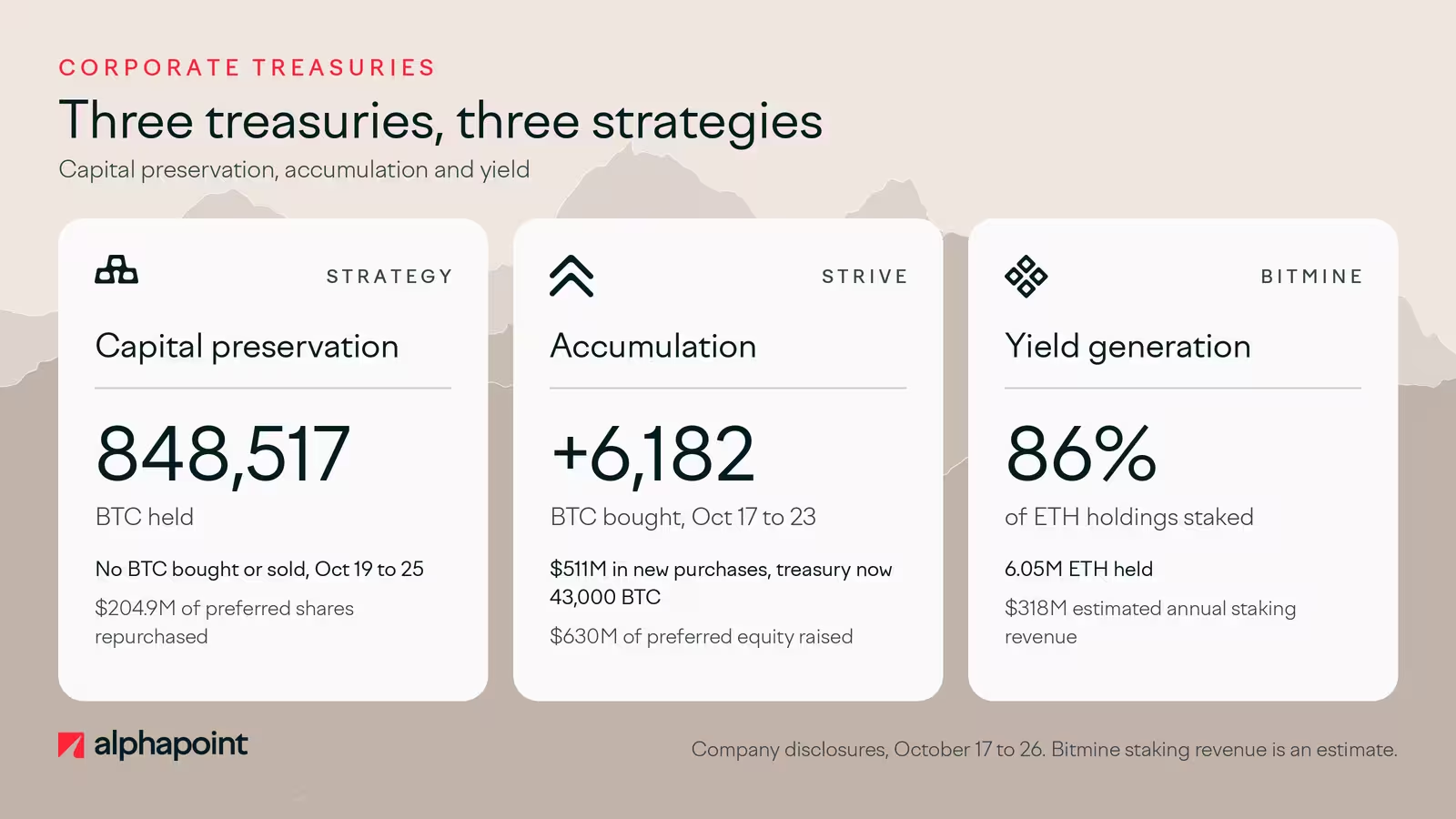
Strategy's October 26 SEC filing confirmed no bitcoin purchases or sales from October 19 to 25, leaving holdings at 848,517 BTC acquired for $64.02 billion at an average price of $75,446. The company repurchased approximately $204.9 million of STRC preferred shares during the period and reported a $4.83 billion USD reserve and $242.4 million of additional USD cash as of October 25.
Strive moved the other way. It bought 6,182 BTC for approximately $511 million between October 17 and 23, bringing its treasury to 43,000 BTC. The company completed an offering of 7 million preferred shares on October 20, raising approximately $630 million before expenses with a 15% annual dividend, and established an at-the-market program for up to $1 billion of SATS preferred stock.
Bitmine added 10,452 ETH over the week, reaching 6,051,933 ETH, about 4.95% of Ethereum's circulating supply. Of that, 5,227,037 ETH, or about 86%, was staked. The company estimated $318 million in annualized staking revenue, rising to $368 million if its entire balance were staked, and repurchased 2.04 million of its own shares during the week.
Corporate treasuries are becoming differentiated financial structures. Strategy is managing preferred-share liabilities and reserves, Strive is financing additional bitcoin accumulation, and Bitmine is turning its ether holdings into a staking-supported balance sheet. Their funding structures and recurring cash obligations may become as important to investors as their underlying crypto exposure.
Sources & Market Signals
Federal Reserve | October 28 Held its benchmark rate at 3.75%–4.00%, with two dissenters favoring a hike. Markets initially reacted modestly before crypto prices weakened later in the week. Source: Federal Reserve | Reuters
Farside Investors | October 23–29 US spot Bitcoin ETFs recorded $302.9 million in net inflows, while Ethereum ETFs saw $271.3 million in net outflows. Sources: Bitcoin ETF flows | Ethereum ETF flows
Binance | October 29–30 Reported a major security breach, with losses estimated at approximately $6.3 billion. Around $3 billion in assets were reportedly frozen, and Binance committed to covering affected customer balances. Sources: Binance security announcement | Reuters | Financial Times
Strategy | October 26 Reported no Bitcoin acquisitions between October 19 and 25, maintaining holdings of 848,517 BTC while repurchasing approximately $204.9 million in preferred shares. Source: SEC Form 8-K
Strive | October 23–26 Acquired 6,182 BTC for approximately $511 million, bringing holdings to 43,000 BTC, supported by preferred-equity financing. Source: Strive corporate announcement and SEC filings
Bitmine | October 26 Reported 6.05 million ETH in treasury holdings, with approximately 86% staked and $318 million in estimated annualized staking revenue. Source: SEC filing
CFTC | October 5–13 Introduced proposed Regulation CTX and CAM frameworks addressing leveraged retail crypto transactions and specialized crypto trading venues. Source: CFTC announcement
SEC | October 23 Published FY2027 examination priorities, identifying cybersecurity, operational resilience, third-party risk and emerging financial technologies as supervisory areas. Source: SEC announcement
DTCC | October 28 Launched a tokenization service supporting selected US equities, ETFs and Treasuries, with 20 participating institutions including Morgan Stanley, JPMorgan and Citi. Source: DTCC Official Announcement | Reuters
Coinbase / Base | October 29 Tokenized equities reportedly exceeded $4 billion in cumulative decentralized exchange trading volume, with liquidity concentrated on Aerodrome. Sources: Crypto Briefing | Bitquery
OKXICE | October 23–29 Faced growing objections from publicly traded companies over plans to enable tokenized equity trading, highlighting unresolved issuer consent and market structure questions. Sources: Reuters, October 23 | Financial Times
Morgan Stanley | October 2026 Advanced its participation in institutional tokenized securities infrastructure, including DTCC's newly launched service and plans for tokenized equity trading. Sources: DTCC | Morgan Stanley