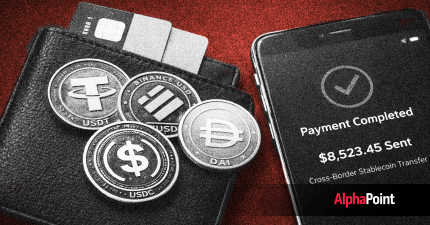
Stablecoin Payment Platforms & Infrastructure: The Enterprise Guide for 2026

The institutional adoption of stablecoin payment platforms has shifted from experimental to essential. With on-chain stablecoin transaction volume exceeding $8.9 trillion in H1 2025 and the market cap surpassing $300 billion, financial institutions that ignore this infrastructure do so at their competitive peril.
This isn’t speculation. According to EY-Parthenon research conducted after the GENIUS Act passage, 54% of non-users expect to adopt stablecoins within 6-12 months, and 77% of corporates cite cross-border supplier payments as their top use case. For regional banks, payment service providers (PSPs), and fintechs processing high volumes, understanding stablecoin payment infrastructure is now table stakes.
Why Enterprise Stablecoin Payment Infrastructure Matters Now
The legacy correspondent banking system was built for a different era. Cross-border B2B payments still take 3-5 business days, involve multiple intermediaries, and carry opaque fees that erode margins. Stablecoin payment rails solve these structural inefficiencies.
According to the 2025 McKinsey Global Payments Report, stablecoin usage has shifted from purely speculative trading toward tangible commerce. While total transaction volumes remain dominated by exchange activity, actual commerce-related payments more than doubled in 2025, now representing approximately 10% of total stablecoin transaction volume. This growth is driven largely by the B2B segment, which accounts for roughly $226 billion or about 60% of all “real” stablecoin payment volume, as businesses increasingly adopt these assets for cross-border settlements and treasury management.
The business case for B2B stablecoin payment networks centers on three advantages:
▸ Settlement speed: Near-instant finality versus 1-5 day correspondent bank settlement
▸ Cost reduction: EY-Parthenon found 41% of current stablecoin users report cost savings of at least 10%, primarily in cross-border B2B payments
▸ 24/7 availability: Operations continue outside banking hours, eliminating timezone-dependent delays
Core Components of Stablecoin Payment Architecture
Building or selecting a stablecoin payment gateway requires understanding the architectural layers that underpin reliable enterprise stablecoin payment systems.
Wallet Infrastructure and Custody
Enterprise-grade stablecoin payment platforms require MPC (multi-party computation) wallet infrastructure that balances security with operational flexibility. The custody model you choose, self-custody, third-party, or hybrid, determines your regulatory obligations and control over funds.
For institutions processing above $5M monthly volume, a client-controlled, non-custodial posture often provides the optimal balance. This approach keeps stablecoins on your balance sheet while leveraging institutional-grade security controls including role-based access, multi-user approvals, whitelisted withdrawal addresses, and velocity limits.
On-Ramp and Off-Ramp Integration
The stablecoin payment flow from fiat to stablecoin and back represents the critical integration point where many implementations fail. Off-ramp challenges in cross-border payments, including limited financial infrastructure and local liquidity constraints remain the primary friction point for enterprise adoption.
The most effective stablecoin payment solutions offer two operating modes: software-only mode for organizations already holding stablecoins that need treasury workflow tooling, and bundled rails mode with integrated fiat conversion and FX services for end-to-end processing.
Compliance and KYT Infrastructure
Regulatory frameworks are crystallizing rapidly. The U.S. passed the GENIUS Act in July 2025, the EU’s MiCA regulation is now fully applicable, and Hong Kong enacted its Stablecoin Bill. These frameworks mandate specific requirements for reserves, audits, transparency, and AML/KYC controls.
Any secure stablecoin payment infrastructure must integrate: KYB and beneficiary screening for onboarding, sanctions screening and chain analysis for address risk, KYT (Know Your Transaction) pattern monitoring for suspicious activity, and governance controls including approval workflows and velocity limits.
Evaluating Stablecoin Payment Providers: What CXOs Should Prioritize
When comparing stablecoin payment processor options, enterprise buyers face a fundamental choice: retail-grade platforms with percentage-based pricing, or institutional infrastructure with flat SaaS economics.
Pricing Models: Percentage vs. Flat SaaS
Retail payment platforms like Coinbase Commerce typically charge around 1% per transaction. At $5M monthly volume, that’s $50,000 monthly in transaction fees alone. For high-volume operators, this pricing model is unsustainable.
The best stablecoin payment platforms for businesses offer flat subscription pricing with zero basis-point fees for on-platform activity. Fees apply only to fiat conversion and FX services when used. This model transforms unpredictable transaction costs into fixed operational expenses.
Stablecoin Payment API Capabilities
Enterprise deployments require robust stablecoin payment API capabilities. Evaluate providers on API-first architecture supporting RFQ-style workflows, webhook integrations for real-time transaction status, bulk import and automation for high-volume payout operations, and analytics dashboards with reconciliation tooling.
The best stablecoin payment APIs for developers provide comprehensive documentation, sandbox environments, and dedicated integration support; not just basic REST endpoints.
Stablecoin Issuer Integrations
Leading stablecoin payment infrastructure providers offer direct mint and burn integrations with major issuers including USDT, USDC, USDG, and PYUSD. At scale, particularly above $30M monthly volume, mint and burn access avoids retail order book costs and liquidity constraints that become material at enterprise volumes.
Real-World Enterprise Stablecoin Payment Use Cases
The shift from proof-of-concept to production deployment is accelerating. Adoption among traditional B2B players is being driven by operational necessity, not speculative interest.
Cross-Border B2B Settlement
Zeebu, a blockchain-based telecom payments platform, processed $5.7 billion in transactions and settled 99,000 B2B invoices across 139 active carriers using stablecoin payment processing. For Zeebu, stablecoins unlocked growth in a $120B global market where traditional rails created friction.
Mass Payouts and Disbursements
Gig economy platforms, marketplaces, and content platforms are deploying stablecoin payment systems for contractor and creator payments. Scale AI offers overseas contractors payment in stablecoins, ensuring stable-value payments regardless of local currency volatility. Global payroll platform Deel launched stablecoin payouts for contractors across 69+ countries.
Treasury Operations and Working Capital
Stablecoin treasury management enables institutions to hold digital dollars while maintaining spending flexibility. Active stablecoin wallets increased from 19.6 million in February 2024 to over 30 million in February 2025, a 53% year-over-year growth according to industry data. This expansion reflects widening enterprise adoption beyond crypto-native applications.
What’s Next for Stablecoin Payment Networks
EY-Parthenon projects that 5-10% of cross-border payments will be made using stablecoins by 2030, representing $2.1 trillion to $4.2 trillion in value. The stablecoin payment providers building infrastructure today will capture a disproportionate share of this growth.
The convergence of regulatory clarity (GENIUS Act, MiCA), major payment network integration (Visa, Mastercard, Stripe partnerships), and proven enterprise use cases points to sustained acceleration. As William Blair’s research notes, stablecoins enable “programmable money” through smart contracts and immutable transaction rules that dramatically improve upon fiat-based cross-border commerce.
For regional banks and PSPs, the question isn’t whether to adopt stablecoin payment solutions, but how quickly you can deploy institutional-grade infrastructure before competitive pressure makes it urgent.