BLOG ARTICLE
Stablecoin Treasury Management ROI: How to Calculate Costs, Savings, and Payback


What is stablecoin treasury management?
Stablecoin treasury management is the set of systems and controls a finance or treasury team uses to source, hold, approve, move, reconcile, and report stablecoin funds.
Its ROI comes from a specific set of avoided costs and replaced operations, not from any single feature: avoided percentage-based transaction fees, reduced FX spread on cross-border movement, lower liquidity spread on mint-and-burn activity, faster settlement (less cash tied up in transit), reduced manual reconciliation and payout labor, and the avoided cost of building equivalent infrastructure internally. Every calculator linked in this guide measures one of those line items against your own numbers.
How do you calculate stablecoin treasury ROI?
Stablecoin treasury ROI is the net annual value you get back, avoided costs plus operational benefit, minus what the platform costs , expressed as a percentage of that platform cost. Payback period is how long it takes your net savings to cover any upfront implementation cost.
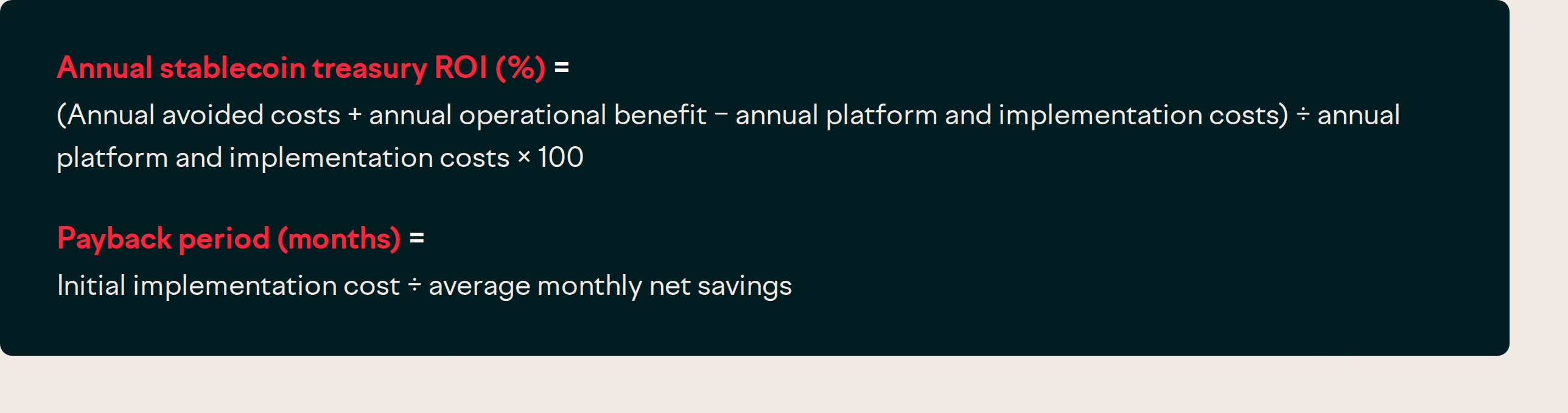
Each calculator below is a specialized version of this same formula. Each one isolates a different “annual avoided cost” term , FX spread, percentage-based fees, liquidity spread, or payout platform fees , and compares it against Alphapoint's flat SaaS pricing for whichever tier your volume lands in.
Example
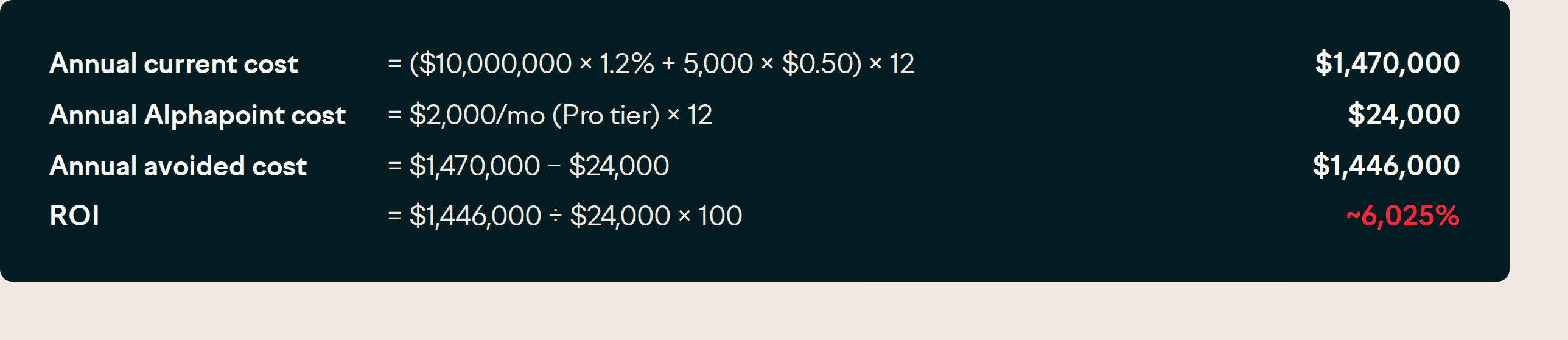
Using the Cross-Border ROI Simulator's own inputs as an illustration: a business moving $10M a month across borders, running 5,000 payments a month, currently paying a 1.2% FX spread.
Assumptions and limitations
- The $0.50-per-payment manual-ops estimate and the 1.2% FX spread are illustrative starting values in the Cross-Border ROI Simulator , replace them with your own numbers; the tool's output will change accordingly.
- Alphapoint's $500 / $2,000 / $10,000 monthly tiers and their $1M / $10M / $50M included-volume breakpoints are Alphapoint internal evidence , our own published commercial tiers, not a third-party benchmark.
- This example excludes one-time implementation cost (Alphapoint's Base and Pro tiers are self-serve with no stated setup fee; Enterprise deployments involving custom integration should get an implementation estimate from your Alphapoint contact before calculating payback).
- It also excludes operational benefits that are real but harder to quantify generically , e.g., faster settlement freeing up working capital , which is why the field guide below treats each use case's ROI separately rather than as one blended number.
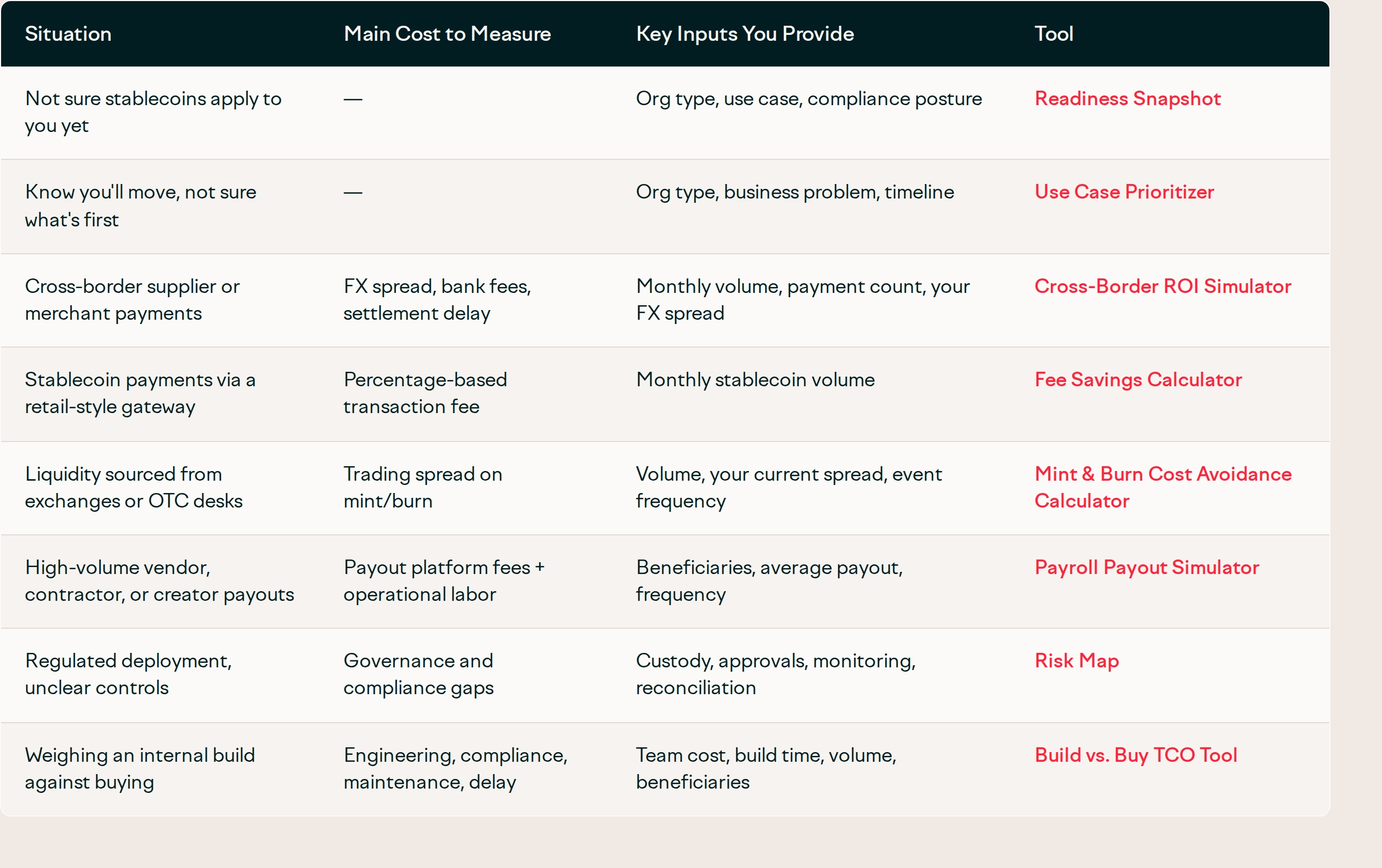
At a glance: which analysis fits your situation?
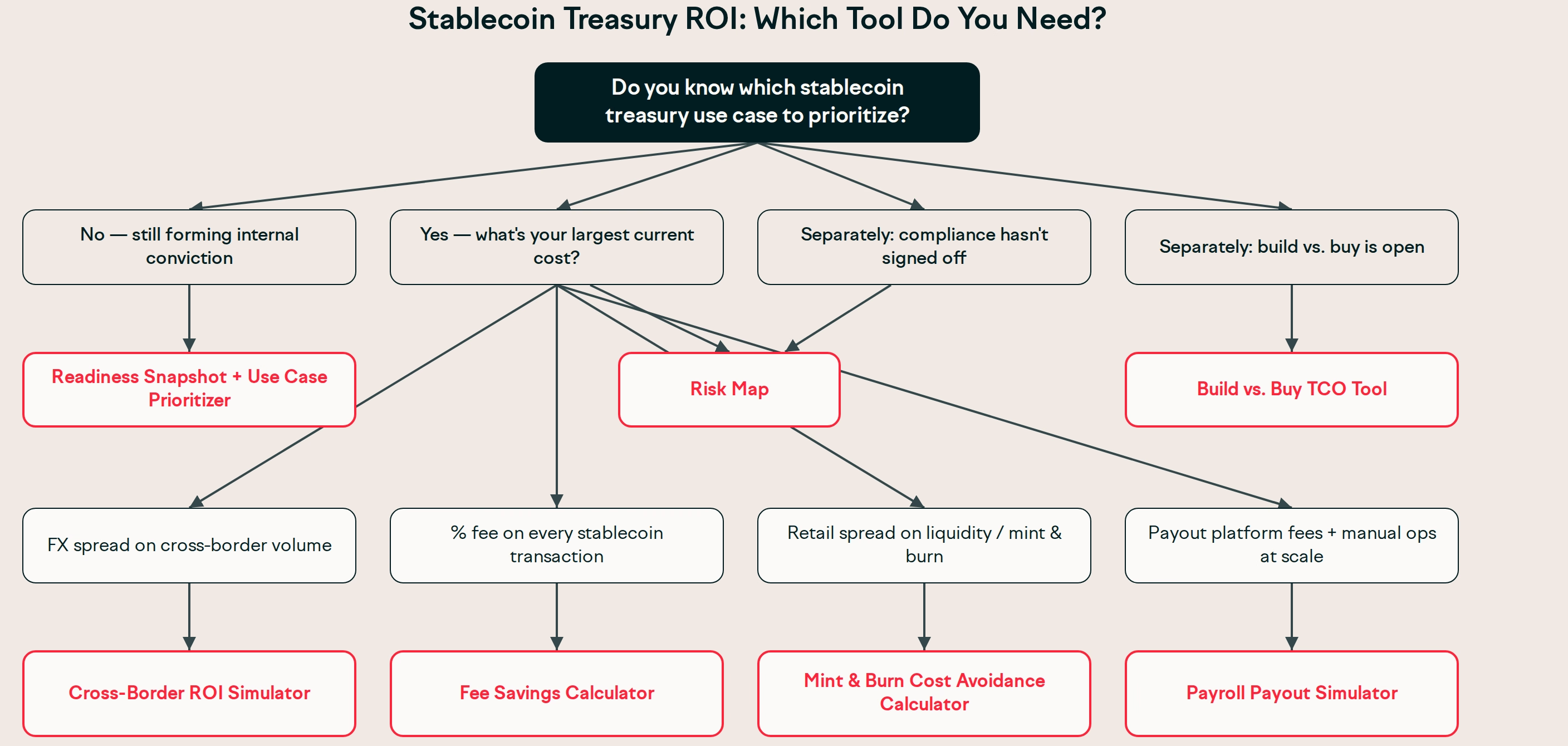
A visual path through the decision
Before you calculate ROI: readiness and use-case prioritization
If you haven't yet confirmed your organization is positioned to move, or you know you want to act but haven't picked a first use case, start here rather than at a cost calculator , the number a calculator gives you is only useful once you know which problem you're solving.
Best for: treasury, payments, or innovation teams who are convinced stablecoins matter but haven't confirmed their organization is positioned to move (a PSP whose compliance team hasn't weighed in, a bank with a board mandate but no internal owner), and teams with buy-in who are debating whether the first deployment should be payment acceptance, mass disbursements, cross-border settlement, or internal treasury management.
What each tool covers
- Readiness Snapshot: 8 questions on organization type, priority use case, compliance posture, and internal systems , returns one of three outcomes: still exploring, pilot-ready, or ready to evaluate.
- Use Case Prioritizer: 7 questions on organization type, the business problem you're solving first, who benefits most, and your timeline , returns the single use case most likely to succeed as a first deployment.
Assumptions and limitations
Both tools are self-assessments , they classify your situation based on what you tell them, and don't pull in outside data or benchmark you against other companies' answers. Treat the output as a starting point for an internal conversation, not a verified diagnosis.
Related reading: stablecoin adoption for business treasuries, the strategic questions financial leaders are weighing on treasury platform strategy, and the range of stablecoin use cases institutions are deploying first.
How much can stablecoin cross-border payments save?
For a business moving meaningful cross-border volume, the savings come primarily from replacing FX spread and correspondent-banking costs with a flat monthly fee , the more volume you move, the larger the gap, because the current-cost side scales with volume and Alphapoint's fee mostly doesn't.
Best for: PSPs running payouts across multiple countries, manufacturers and importers/exporters paying overseas suppliers, and global platforms settling in emerging markets where direct issuer access is limited.
Costs to include
- FX spread on the converted amount
- Correspondent or intermediary bank fees
- Manual reconciliation labor across currencies and jurisdictions
- The cost of settlement delay (cash tied up in transit for one to several days)
Worked example
At $10M in monthly cross-border volume, 5,000 payments a month, and a 1.2% FX spread:

Assumptions and limitations
- Illustrative assumption: the 1.2% FX spread and $0.50-per-payment ops estimate are defaults in the tool, enter your own current spread and payment volume for an accurate number.
Cited industry evidence: correspondent-banking cost and settlement-time ranges reported in industry analyses of B2B cross-border payments commonly cite figures in the low single digits to mid single digits of percent, with settlement measured in business days rather than hour , see Spark Money's research on cross-border B2B payments (which draws on McKinsey's 2025 Global Payments Report) for the underlying figures. This is directional industry commentary, not a single regulator-audited dataset, and B2B corridors differ from the World Bank's Remittance Prices Worldwide consumer-remittance benchmark (global average ~6.3–6.5% as of 2025), which measures small individual transfers rather than business payments.
- Alphapoint internal evidence: the $500 / $2,000 / $10,000 tier structure and $1M / $10M / $50M volume breakpoints are Alphapoint's own published commercial tiers.
Related reading: the definitive guide to cross-border global payments with stablecoins and how stablecoin payment integration is reshaping global money movement.
Run the Cross-Border ROI Simulator →
When does flat SaaS pricing beat percentage-based fees?
A percentage-based fee costs more in absolute terms every time your volume grows; a flat SaaS fee doesn't. The crossover point depends on your volume and your current fee rate , at meaningful volume, flat pricing wins by a wide and growing margin.
Best for: self-serve PSPs and fintechs currently running stablecoin flows through a retail-style processor charging roughly 1% per transaction.
Costs to include
- Your current percentage-based processing fee, applied to monthly volume
- Alphapoint's flat SaaS fee for the tier your volume falls into
Worked example
At $10M in monthly stablecoin volume, comparing a 1% processing fee to Alphapoint's Pro tier:

Assumptions and limitations
Cited external evidence: the 1% comparison figure matches Coinbase Commerce's own published fee schedule , “a 1% fee to all transactions,” per Coinbase's developer documentation , which is the specific retail-style gateway Alphapoint's own competitive research uses as a reference point. Other retail processors' rates vary; check your own statement before assuming 1% applies to you.
- Alphapoint internal evidence: the tier structure and breakpoints are Alphapoint's own published pricing.
Related reading: USDC settlement infrastructure built for enterprise compliance and stablecoin payment platform infrastructure built for scale.
When does direct stablecoin mint-and-burn access become economical?
Retail order-book or OTC sourcing is a reasonable starting point at low volume, but the spread you pay doesn't shrink as volume grows , so the case for direct issuer access through APG strengthens as your monthly mint/burn volume increases, typically becoming clearly favorable well before $30M/month.
Best for: PSPs and fintechs sourcing stablecoin liquidity through retail order books or OTC desks as monthly volume climbs.
Costs to include
- Your current retail or OTC spread, applied to mint/burn volume
- Alphapoint's flat SaaS fee plus its reduced on/off-ramp basis-point rate for the applicable tier
Worked example
At $10M in monthly mint/burn volume and a 50 basis-point (0.50%) retail spread:

Assumptions and limitations
- Illustrative assumption: the 50 bps default spread is a placeholder , enter your own current spread; retail and OTC spreads vary by desk, asset, and market conditions and Alphapoint does not publish a universal “typical” retail spread.
- Alphapoint internal evidence: the $500 / $2,000 / $10,000 tiers and the 0.25% / 0.15% / 0.10% on/off-ramp basis-point rates by tier are Alphapoint's own published pricing.
Related reading: the enterprise infrastructure guide to multi-chain stablecoin payments and takeaways from our stablecoin treasury and payments liquidity webinar.
Calculate Your Mint & Burn Savings →
How do stablecoin payouts affect payroll and beneficiary costs?
The savings case for mass payouts depends less on a headline percentage and more on what breaks at scale in exchange-based or manual workflows , role-based approvals, whitelisted addresses, velocity limits, and an audit trail , which a flat per-beneficiary-tier fee is built to replace.
Best for: marketplaces and gig-economy platforms, manufacturers paying large supplier or contractor networks, and payroll or disbursement teams managing recurring payout runs.
Costs to include
- Your current payout platform's fee structure, applied to your beneficiary count, average payout, and frequency
- Alphapoint's flat SaaS fee for the tier your beneficiary count falls into
Worked example
At 250 beneficiaries, an $800 average payout, and 2 payout runs a month:

Assumptions and limitations
Illustrative assumption, flagged for review: the tool compares Alphapoint's fee to a “typical payroll platform, 1.5% of payout volume.” Published market pricing for global payroll and contractor-payment platforms is structured almost universally as a per-employee-per-month fee , commonly
$20–$50 PEPM according to a 2026 payroll pricing guide (People Managing People), not a percentage of payout volume. A percentage comparator may still be a fair proxy for smaller, ad hoc, exchange-based payout workflows (which is the actual competitive set for this use case), but it isn't a verified benchmark against named payroll platforms. Recommend validating or reframing this comparator with Rakhin before publishing.
- Alphapoint internal evidence: the $500 / $2,000 / $10,000 tiers and 200 / 2,000 / 5,000 included-beneficiary breakpoints are Alphapoint's own published pricing.
Related reading: the institutional playbook for stablecoin invoicing, which covers the same reconciliation and governance requirements from the receivables side.
Simulate Your Payout Savings →
Which controls does a stablecoin treasury operation require?
A regulated institution's real blocker is usually not “is this legal” but “have we defined the controls” , custody and access, transaction approval workflows, fiat-conversion handling, reconciliation, system connectivity, and incident monitoring all need an answer before compliance will sign off.
Best for: banks and regulated PSPs where legal, compliance, or risk hasn't yet validated the operational model , often the real blocker even after the business case is settled.
Costs to include
This section is a control assessment rather than a cost calculation. The relevant “cost” is the risk and delay of an undefined control area, not a dollar figure.
Control areas the assessment covers
- Custody, access, and control of stablecoin assets
- Transaction initiation, approval, release, and review authority
- Fiat-to-stablecoin and stablecoin-to-fiat conversion handling
- Reconciliation and reporting
- Internal and external system connectivity (ERP, TMS, core banking, custody, KYC/KYT)
- Monitoring and escalation for suspicious activity, failed transactions, and exceptions
Assumptions and limitations
This is a self-assessment, not a compliance audit or legal opinion , it identifies which control areas are already defined internally and which still need an owner. It does not substitute for review by qualified compliance or legal counsel.
On the regulatory backdrop: the GENIUS Act was signed into law on July 18, 2025, establishing the first comprehensive US federal framework for payment stablecoins. As of this writing, implementing rules are still in progress , Treasury (FinCEN/OFAC), the OCC, and the FDIC have each issued proposed rules, and the Act's one-year rulemaking deadline passed without final rules in place. The GENIUS Act takes effect no later than January 18, 2027, or 120 days after final implementing rules are issued, whichever comes first.
Sources: FDIC, OCC, U.S. Treasury, and the Chapman and Cutler GENIUS Act rulemaking tracker.
Related reading: stablecoin adoption inside banking, the 2026 roadmap for bank stablecoin payment integration, and our coverage of the GENIUS Act for readers whose compliance team is still forming a view, note that post predates the rulemaking developments summarized above and should be read alongside them.
Should a bank build or buy stablecoin treasury infrastructure?
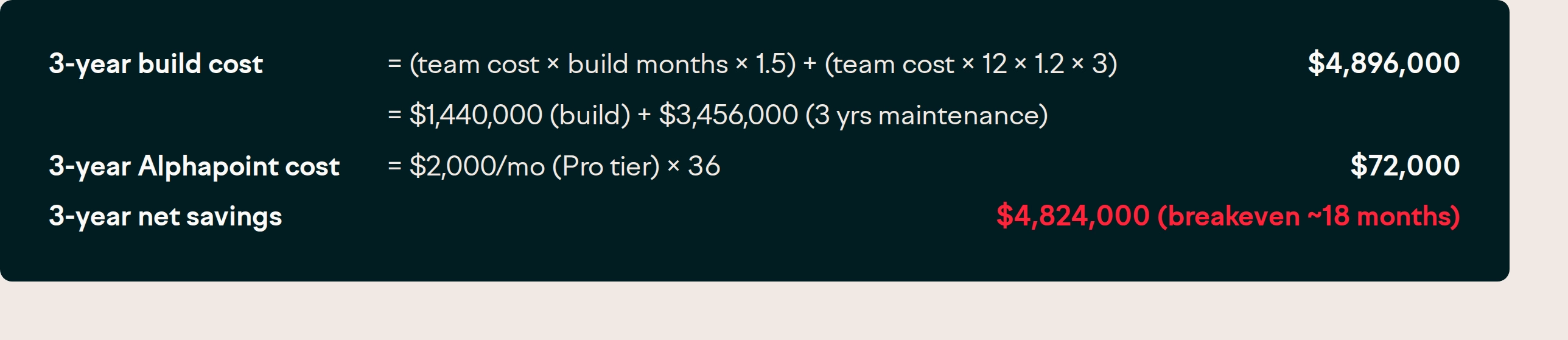
Direct answer: An in-house build looks cheaper before you count ongoing maintenance, the compliance rebuild, and the months before it's production-ready , the comparison that matters is 3-year total cost of ownership, not the first year's engineering budget.
Best for: regional banks, large enterprises, and tokenization platform builds weighing an internal engineering team against buying treasury infrastructure outright.
Costs to include
- Internal dev-and-ops team cost, upfront build period, and ongoing maintenance
- Alphapoint's flat SaaS fee for the tier matching your volume and beneficiary count, over the same period
Worked example
At $10M monthly volume, 500 beneficiaries, an $80,000/month internal team cost, and a 12-month build timeline:
Assumptions and limitations
- Illustrative assumption: the $80,000/month team cost and 12-month build time are adjustable defaults in the tool, not asserted industry averages , set both to your own institution's real numbers.
- Illustrative assumption: the 1.5x upfront overhead multiplier and 1.2x ongoing maintenance multiplier are the tool's built-in modeling assumptions for compliance, infrastructure, and maintenance overhead on top of raw team cost, not a sourced third-party benchmark.
- Alphapoint internal evidence: the $500 / $2,000 / $10,000 tiers and volume/beneficiary breakpoints are Alphapoint's own published pricing.
Related reading: stablecoins and tokenization as a treasury imperative and what financial institutions need to know about stablecoin treasury platform strategy.
Frequently asked questions
Does Alphapoint charge fees on top of what these calculators show?
Alphapoint's flat SaaS tiers ($500 / $2,000 / $10,000 per month based on volume) cover on-platform activity at zero basis points. Fees apply separately for fiat conversion, on-ramp/off-ramp, and FX services when used, these aren't included in the calculators' flat-fee comparison and should be added for a complete picture.
Do these calculators use Alphapoint customer data?
No. Each calculator uses either your own inputs, a specific named external benchmark (linked in the relevant section above), or a clearly labeled illustrative default. None of the comparison figures are drawn from an Alphapoint customer dataset or survey.
Which pricing tier will my organization land in?
Base ($500/month) includes up to $1M in monthly volume and 200 beneficiaries. Pro ($2,000/month) includes up to $10M and 2,000 beneficiaries. Enterprise ($10,000/month) includes up to $50M and 5,000 beneficiaries, with custom terms beyond that. Each calculator above auto-selects the tier that minimizes your total cost at your volume.
Putting it together
The Readiness Snapshot and Use Case Prioritizer are the front door for anyone still building internal conviction. The four ROI calculators, cross-border, fee savings, mint & burn, and payroll , each turn one specific operational pain point into a real number using the formula above. The Risk Map and Build vs. Buy tool exist for the internal conversation that comes after: the one with compliance, IT, or the board.
If you've already got a number in hand, the fastest next step is a live walkthrough, you can see the platform in action from our FinovateSpring 2026 demo, or go straight to booking time with the team.